Table Of Contents
- What is Scalping?
- What is a FOREX scalping signal?
- How can Arincen help with scalping signals?
- What’s the difference between signals, copy trading, and EAs?
- Why is cost control critical in scalping?
- What Are the Best Indicators for Scalping Signals?
- How Providers Show a Scalping Setup
- What should you check before following a scalping signal?
- When do scalping signals help, and when don’t they?
- What red flags should you watch for with scalping signals?
- Are Scalping Signals Worth It?
- Conclusion
Forex Scalping Signals: How They Work and How to Choose a Provider
FOREX scalping signals promise traders a faster way to spot opportunities in a market shaped by economic forces, market makers, and constant price noise. For retail traders trying to gain an edge, that promise can sound especially appealing. This guide from Arincen explains what scalping signals are, where to find them, how providers package them, where they can help through discipline and idea flow, where they can hurt through slow execution and high costs, and how to test them on demo, then micro-live, before risking more capital.
The biggest performance gap between a provider’s results and a follower’s is often not the entry idea itself, but whether the follower can reproduce the provider’s spread, slippage, and execution speed in live conditions.
Scalping signals only work if your round-trip cost (spread + commissions + slippage + funding) stays roughly less than 1–2 pips on majors during liquid sessions.
Latency kills edges. If your average entry drift vs the provider exceeds ~0.5-1.0 pip, expect their stats to underperform in your account.
The best setups use volatility/structure-based SL/TP, not fixed pip counts, and include explicit time-in-force to avoid stale fills.
Verification is non-negotiable: look for 6-12 months and 200-500+ trades with third-party stats, and not just win rate.
Choose a delivery method that matches your speed needs. For example, a notification via your broker’s app is faster than email.
Broker fit matters. Look for tight raw spreads, stable market execution, small min stop distance, reliable server-side stops, and transparent financing.
Run a two-phase test. Look to demo for plumbing, then micro-live for 100-200 trades. Scale only if the profit factor is greater than 1.2 and expectancy is greater than +0.05-0.10R after costs.
If you can’t meet these thresholds, step up in timeframe or go self-directed, where you control context and cost and aren’t constrained by provider latency.
What is Scalping?
Scalping is an ultra-short-term trading style where you open and close positions within seconds to a few minutes. You end up doing this dozens or even hundreds of times per session, with profit targets measured in just a few pips and losses kept equally tightly controlled. It’s about exploiting very small price moves through very many round-trips rather than holding for broader trends.
Because each trade only has a tiny edge, market microstructure, the structure behind how orders get quoted and filled, matters more than usual. The spread is your first challenge, as paying the bid–ask on every entry/exit can erase a 2–3 pip target if the pair isn’t highly liquid or your broker widens spreads in volatile moments.
Successful scalpers focus on the most liquid pairs (like majors) and the right sessions to keep costs microscopic and optimize execution, platform speed, order type, and fills.
This is because, in scalping, microstructure often determines whether a seemingly small edge shows up in your P&L.
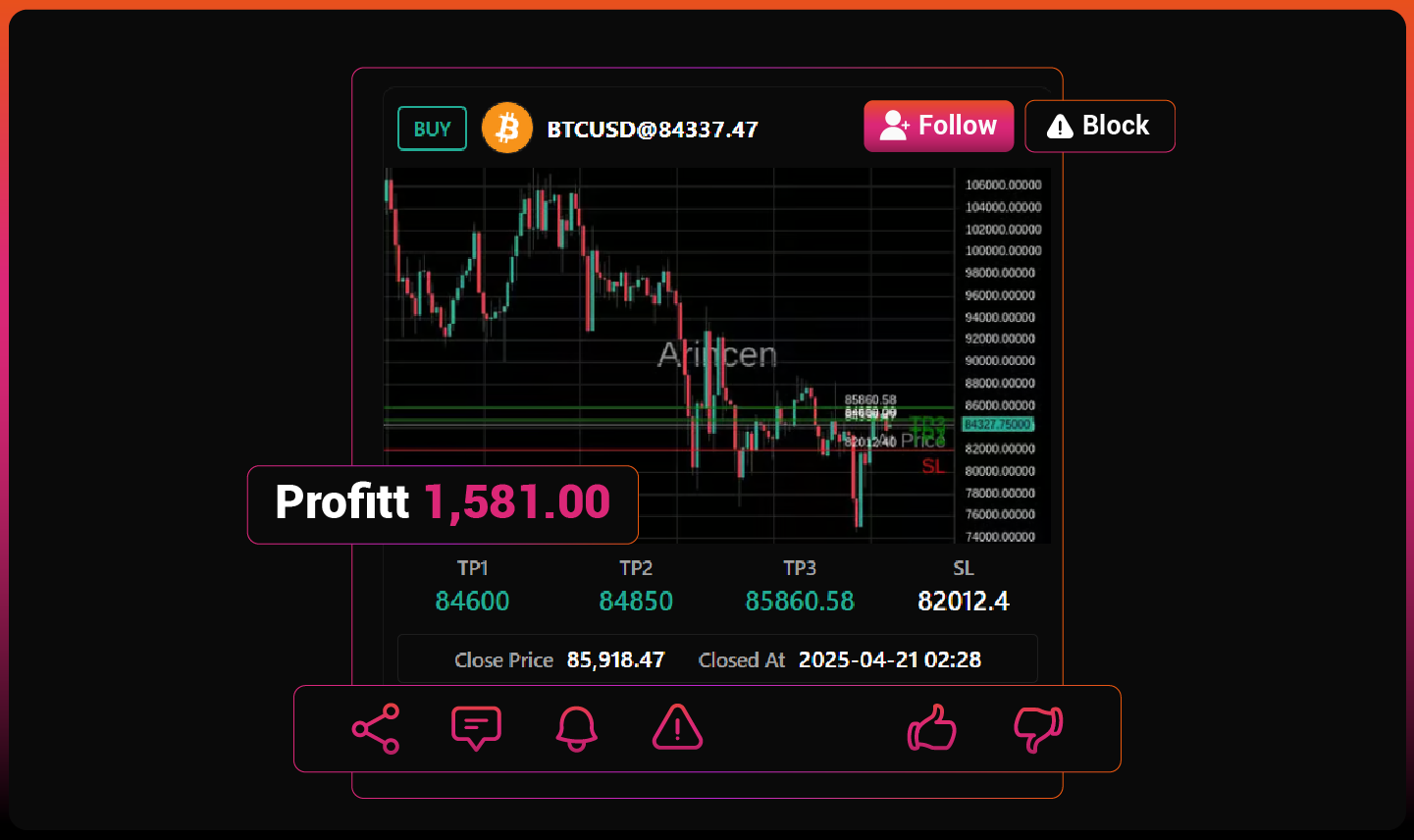
Trade with Real-Time Expert Signals
Follow live signals from experienced traders.
Get entry price, TP levels, SL, and closure updates.
Receive instant alerts when targets or stops are hit.
Track performance with clear, transparent stats.
Stay aligned with the market in real time.
What is a FOREX scalping signal?
A FOREX scalping signal is a trade alert that tells you what to trade, when to enter, and where to place risk and profit targets. In practice, it gives scalpers a fast, structured setup they can act on within seconds or minutes. The value of these signals depends on how clear the instructions are and whether the timing fits a scalping strategy.
Signals are designed to prompt a trader to act at a certain time. This can help traders who are unsure how to proceed, although the decision and the risk remain theirs.
A signal comes as a pulse of information about a certain pair of currencies in the form of a recommendation to buy or sell at a predetermined price and time. Signals are generated either by human traders or by automated algorithms. Here are some differences between the two:
Human: Discretionary judgment; adaptive to context; slower/less consistent timing.
Algo: Rules-based; consistent and fast; limited to what’s coded.
For newer traders, signals can show how experienced traders structure a trade (entry, stop loss and take profit) while they are still learning. They do not guarantee profits, and losing signals are part of every real track record.
Signals can be configured to fit the lifestyle of any trader.
SMS alerts to your phone
email blasts
trading app push notifications
FOREX signals are generated from a complex web of inputs. Signals could be the result of fundamental analysis combined with everyday technical analysis from chart-based information, supplemented with information from news and current affairs. The more relevant inputs a signal draws on, the better it can account for market context, but no combination of inputs makes a signal certain.
When we talk of the inputs into making a signal-based decision, this is what we are talking about:
Price action: Uses structure (breakouts, pullbacks) that are found on charts, for example.
Indicators: Quantifies trend/momentum/volatility movements.
News: Captures catalyst moves, but can create higher slippage and spread risk.
Technical analysis is one of the most important sources of information to feed into signals. Technical analysis involves reviewing past price action, focusing on prior prices and support and resistance levels. This form of analysis is a great way to uncover shorter-term trends that benefit traders who use intraday trading strategies.
By comparison, fundamental analysis is more suitable for longer-term investments based on important country-level macroeconomic information.
Much more information goes into a fundamental analysis at a national level, such as:
inflation data
manufacturing output
unemployment figures
For the trader, a FOREX signal is useless if not acted upon at the right time. The market is dynamic and fast-moving, meaning that buy and sell decisions must be acted upon before the information becomes dated and unreliable.
FOREX signals come with different utilities to traders. Some are low-grade signals that almost anyone could figure out for themselves, such as a directional move of a currency pair. Others are much more valuable. The best signals include such important information as information on when the best time to take a profit (TP) or invoke a stop loss (SL).
How can Arincen help with scalping signals?
Arincen is an investment community platform built to help users make smarter decisions through data, tools, and expert insight. It is not a broker; instead, it gives traders and investors a clearer way to discover opportunities, evaluate experts, and act with more confidence.
Signals: Real trade ideas with clear entry price, TP1, TP2, TP3, stop loss, and manual closure updates.
Statistics: Transparent expert performance, including win rates, market specialties, and track records, so users can see who delivers before following.
Notifications: Instant alerts for signals, market moves, comments, and expert activity.
Portfolio Tracker and Watchlist: Monitor trades and follow key instruments across thousands of assets.
Learning Hub and AI Assistant: Gain market understanding, interpret signals, and sharpen decision-making inside the platform.
Rather than relying on a single-guru model, Arincen brings together community, transparency, and practical tools under one roof — true to its promise: Smarter Decisions, Together.
What’s the difference between signals, copy trading, and EAs?
Signals, copy trading, and EAs are different because signals give trade ideas, copy trading mirrors another trader’s positions, and EAs automate execution based on coded rules. For scalpers, that distinction matters because each approach offers a different level of control, speed, and reliance on outside systems. Understanding these differences helps you choose the setup that best fits your risk management and execution style.
Classic signals are trade ideas you receive and execute manually. You keep full control of timing, size, and order type, but every click costs milliseconds, so fills can trail the provider’s price.
Copy trading automates the replication of another trader’s positions in your account, proportionally and in real time. It removes manual steps, which can add latency and produce price drift, partial fills, or sizing mismatches, issues that are especially punishing when targets are only a few pips.
Expert Advisors (EA)/algos are rule-based programs that place and manage trades automatically on your platform/venue. For scalpers, EAs can minimize human reaction time and standardize execution (e.g., instant bracket orders), but your actual edge still depends on spreads, queue priority, and venue speed.
Why is cost control critical in scalping?
Cost control is critical in scalping because the profit on each trade is so small that spreads, slippage, and fees can erase the edge. When your target is only a few pips, every part of the round-trip cost has to stay extremely low. That is why serious scalpers pay close attention to execution, broker pricing, and trading conditions before following any signal.
Total cost per round trip = spread + commissions + slippage + swaps/funding
This equation applies to FOREX and, with slight adjustments, to other assets like stocks, as shown below.
Spread is the bid–ask gap you pay to get in/out. It’s an immediate, implicit cost. Narrower spreads come with higher liquidity and tighter markets.
Commission is explicit on ECN-style accounts (often charged “per side” and quoted per standard lot).
Slippage is the fill difference vs. your requested price, and is common in fast markets. It can be positive or negative, but scalpers must assume a small adverse drift.
Swaps/funding (overnight financing) may be zero for same-day exits, but apply if you hold past rollover. Note that rates depend on the pair and broker schedule.
Worked example (AAPL Stock)
Look at the example as shown in the graphic below:
.webp)
Looking at the chart, there is an opportunity for a quick long from about $217.65 (green line) into about $218.18 (red line); the chart’s data feed shows four decimals ($217.6464 and $218.1825), rounded here to cents. In stock scalping, you’re chasing cents, so round-trip costs matter as much as the setup.
Position size: 100 shares of AAPL
Plan: Buy the pullback, exit at $218.18, hard stop a few cents below the swing.
Assumptions (intraday, flat by close):
Spread: ~$0.01 in liquid hours.
Commissions/fees: “$0 commission” brokers still pass tiny regulatory/venue fees (pennies per 100 shares).
Slippage: assume $0.01 adverse total across entry/exit if using marketable orders.
Financing/borrow: not applicable for a same-day flat long (shorts may incur borrow).
Example fills:
Entry: Limit buy at $217.65 (worked near the bid to avoid paying the full spread).
Exit/TP: $218.18.
Gross move captured: $218.18 − $217.65 = $0.53 × 100 = $53.00.
Round-trip cost (conceptual):
Effective spread: ≈ $0.01 × 100 = $1.00.
Slippage: ≈ $0.01 × 100 = $1.00.
Regulatory/venue fees: a few cents per 100 shares.
Total est. cost: ~$2.05–$2.20, which is about 2¢ per share.
Net result: $53.00 gross − ~$2.10 costs ≈ $50.90 net. Even with a larger target, costs still bite, so stock scalpers trade high-liquidity names (AAPL fits), prefer limit/queue priority, keep latency/routing tight, and size stops/targets by current volatility.
Bottom line: Same equation as FX—price move − (spread + fees + slippage). Keep that bundle to a few cents per share, or even a statistically sound setup won’t show in P&L.
What Are the Best Indicators for Scalping Signals?
For scalpers, the core toolkit is simple:
a trend filter (MA/EMA)
a momentum gauge (RSI or stochastic)
volatility envelope (Bollinger Bands)
MACD can add momentum/trend confirmation when you need it
EMAs react faster than SMAs, which helps on seconds-minute horizons. Many traders pair a fast EMA (e.g., 8-12) with a slower EMA (e.g., 20-26) to define short-term direction.
You should know that RSI frames momentum and mean-reversion. For example, default 14-period settings are common, but scalpers often tighten thresholds around 60/40 in trends to avoid counter-trend traps.
Bollinger Bands surface volatility compression/expansion, useful for “squeeze to break” entries when price rides the band with the trend. Read our detailed Bollinger Bands article here.
MACD blends trend and momentum via EMA spreads. Histogram inflections or zero-line crosses can confirm follow-through after a fast trigger. The stochastic oscillator is another fast momentum tool. Read our article on MACD here.
Typical combos for scalpers:
Trend + pullback: price above a rising EMA pair. This means you enter on a brief dip toward the fast EMA when RSI stays >50 and stochastic turns up.
Volatility break: Bollinger squeeze, then breakout in EMA direction. Seek to confirm with MACD histogram rising from zero to reduce fakeouts.
Range fade (advanced): flat EMAs, band touches with RSI divergence — tight targets only, due to spread/slippage sensitivity.
Top tip:
A key trap is overfitting, stacking too many indicators until a backtest “looks perfect” but fails when tried under real trading conditions. Keep tools limited, roles distinct (trend/momentum/volatility), and validate with out-of-sample and walk-forward testing before risking capital.
How Providers Show a Scalping Setup
Most reputable signal providers publish a compact “payload” so you can execute fast and know the rules of engagement.
A typical scalping ticket includes:
pair
direction
entry (market/limit)
SL
TP
time-in-force (how long the order lives)
a risk note (position size or % of equity to risk)
Better providers also add context:
session
news blackout
what invalidates the idea
Example payload (scalping):
Pair: EUR/USD
Direction: Long
Entry: Limit 1.0752 (valid for 3 minutes)
SL: 1.0745 (≈7 pips below)
TP: 1.0764 (≈12 pips above)
Time-in-force: GTD (good-’til-date/time) – auto-cancel in 3 minutes if not filled
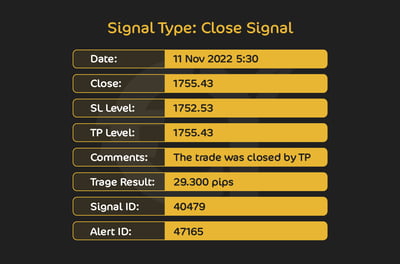
Here is an example of a close-signal ticket issued by a signals provider (a gold trade from November 2022):
Why fixed SL/TP can be inferior for scalpers
Fixed “5-pip stop / 5-pip target” rules ignore regime changes. Scalpers live inside microstructure where spread, slippage, and volatility shift minute by minute. A static 5-pip SL can be too tight during high-vol windows (you get whipped out by normal noise) and too loose when markets are dead (you wait forever to hit TP while costs bleed). It also fails to adjust when spreads widen (your effective stop shrinks) or when the pair transitions from range to breakout behavior.
Top tip:
For scalpers, your edge = tiny. Costs and noise = big. Volatility- and structure-aware SL/TPs keep your stop outside routine chop and your target within what the market is actually paying now, improving fill quality and realized expectancy versus one-size-fits-all pip counts.
What should you check before following a scalping signal?
Before following a scalping signal, you should check the provider’s track record, execution clarity, and whether the setup suits your risk tolerance. You also need to know exactly how entries, stops, and targets are defined so there is no confusion once the market moves. Doing this due diligence helps you avoid poor-quality signal providers and improves your chances of consistent execution.
1) Verified track record (independent analytics)
Look for third-party verification (e.g., Myfxbook/FX Blue with Track Record Verified and Trading Privileges Verified).
Prefer live accounts over demo. Check for consistent broker/timezone stamps and no gaps around news.
Scan equity curve vs. balance curve to spot hidden martingale/grids.
2) Broker compatibility (costs and execution)
Spreads: On your intended pairs, your live spread should be within ~0.1-0.3 pip of what the provider claims during the same session.
Execution policy: Confirm “market execution” vs “instant” (requotes), min stop distance, and whether stops are server-side.
Infrastructure: If signals are fast, plan a low-latency setup (VPS near broker). Test your average slippage in the overlap session.
3) Time zone & delivery speed
Match provider’s active session (e.g., London/NY overlap) to your local time.
Delivery: Push (app/Telegram/API/MT copier) beats delayed email. Measure end-to-end delay: signal time to your fill time must ideally be less than a few hundred ms for market orders, and preferably less than 1-2 seconds for limits.
4) Sample size & drawdown profile (not just win rate)
Try to get at least 6-12 months and 200-500+ trades to judge edge stability.
Prioritize max drawdown, average R, profit factor, and expectancy per trade over headline win rate.
Watch for asymmetric risk (tiny wins, rare big losses), widening average loss, or frequent equity dips post-news.
5) Clear risk method
Provider should state position sizing (fixed fractional or volatility-based), R-multiples for TP/SL, and max open risk (e.g., ≤2% total across all open trades).
Define your caps, such as per-trade risk, daily loss limit, and pause rules after N consecutive losses or after hitting daily DD.
6) Strategy transparency (minimum viable clarity)
Know the setup archetype (trend-pullback, breakout, range fade), time-in-force, and when signals are invalidated.
Prefer volatility-based SL/TP over fixed pip counts. Always confirm how levels adjust during spread spikes.
Follow only when the provider’s verified stats, your broker’s microstructure (spread/latency/slippage), your time zone, and a documented risk framework all line up — and prove it first with a low-risk replication test.
A provider can look disciplined on a verified statement but still become untradeable on a different broker once spread expansion and fill delay are measured ticket by ticket.
When do scalping signals help, and when don’t they?
Scalping signals help when market conditions, execution speed, and trade discipline all support the setup, and they do not help when timing, costs, or volatility break that edge. Because scalping depends on very small price moves, even a decent signal can fail if spreads widen or entries are delayed. Knowing when signals are useful helps traders apply them in the right market conditions and avoid forcing poor trade setups.
Where signals shine:
Signals can shortcut idea generation and impose welcome discipline. You get a defined setup (pair, direction, entry, SL/TP, time-in-force), a clear invalidation point, and fewer “impulse trades.” For busy traders, they’re a way to outsource scanning to someone who lives on the lower timeframes. If your pipeline is tight, including low spreads, low latency, and consistent execution, then signals can keep you focused on risk and process instead of hunting entries. The best FOREX brokers for scalping will give you the right conditions in which to trade.
Where signals disappoint:
Scalping lives in seconds and tiny targets. If you can’t click fast (or your copier adds delay), your fills drift and the edge evaporates. If you’re not comfortable with microstructure noise like wicks, spread spikes, and/or partial fills, you’ll bail early or widen stops until costs eat you. And if round-trip costs sit above ~1-2 pips on majors during the liquid sessions, even good signals won’t translate into your P&L.
Viability vs. self-directed scalping:
Signals are viable when you can replicate the provider’s environment. That means the same session, similar spreads, similar latency, same order types, and a verified edge that still shows positive expectancy after your costs. They’re best for traders who value structure, can follow rules, and have broker/tech tuned for speed.
Self-directed scalping is preferable if you can read tape/structure in real time, adapt stops/targets to volatility, and iterate your own playbook. You avoid provider lag, choose only the cleanest conditions, and optimize entries to your broker’s fill behavior.
Top tip:
If your logged entry drift often exceeds ~0.5-1.0 pip or your expectancy over 100+ replicated trades is ≤0 after all costs, signals aren’t a fit for your setup — either re-architect the pipeline (broker/VPS/sessions) or switch to self-directed methods where you control timing, context, and cost. During the London/NY overlap, even a delay of 1–2 seconds can be enough to turn a workable scalp entry into a chase, which is why execution quality matters as much as the signal logic.
What red flags should you watch for with scalping signals?
The main red flags with scalping signals are vague entries, unrealistic claims, and providers who do not explain risk or execution conditions. These warning signs matter because scalping leaves little room for delay, confusion, or hidden costs. Watching for these mistakes can help you avoid weak signal providers and protect your trading capital.
Too-good promises
“Guaranteed profits,” fixed daily returns, or >80–90% win rates without third-party verification (e.g., Myfxbook/FX Blue with both Track Record and Trading Privileges Verified). Screenshots, PDFs, or hand-picked trade logs don’t count.
Martingale / grids / no real stop
Averaging into losers, “equity protection only,” or moving/widening stops. Equity curves look smooth — until one outsized move wipes months of gains.
No independent stats or tiny samples
Backtests or 2–3 week demos in ideal conditions. Insist on 6–12 months and 200–500+ trades with full metrics (drawdown, profit factor, expectancy, not just win rate).
High-pressure upsells
“Seats closing today,” costly VIP rooms, or paywalls to see basic rules. Real edges don’t need urgency tactics.
Broker or copier conflicts
“Use our broker” with undisclosed rebates/IB deals, unexplained slippage, or signals that only “work” on one venue. If your live spread/latency is worse, your results won’t match.
Opaque risk management
No stated per-trade risk, no max open risk, no daily loss cap. If the provider can’t express targets in R-multiples with clear invalidation, skip.
Hypey reviews
Testimonials vary wildly by broker, geography, latency, and session. Treat Trustpilot/Discord praise as noise; your pipeline may not replicate their fills (survivorship and selection bias are real).
Data and operational risk
Signal delivery via unstable channels (email delays, throttled Telegram), permissioned trade copiers that ask for broad API rights, or no uptime/SLA. Missed or late alerts = negative expectancy for scalpers.
Cherry-picking & curve-fitting
Only posting winners, deleting losing calls, or endlessly tweaking parameters to “fit” last month’s regime. Demand a continuous, timestamped history.
Costs hidden in the fine print
Wide effective spreads during news, extra commissions/swaps, or minimum stop distances that break the stated method. Reconcile fee tables with your live tickets.
Counter-signals and copy risk still carry market risk
Even “hedged” or “uncorrelated” signal mixes can correlate in stress. Copying (or counter-copying) does not remove market risk; slippage and gaps can blow through stops.
Are Scalping Signals Worth It?
They can be, but only under certain conditions:
Only if your costs and speed don’t consume the edge. Benchmark it. Replicate 100+ of the provider’s trades at micro size and compute your expectancy after costs. If your round-trip cost (spread + commissions + slippage + funding) stays ≤ 1-2 pips on majors during London/NY overlap, your entry drift averages < 0.5 pip, and your expectancy remains >0 (in R) with a tolerable drawdown, signals can be viable. If not, the edge you see on their dashboard won’t show up in your P&L.
Quick rule:
Viable: your realized profit factor ≥ 1.2, expectancy ≥ +0.05–0.10R per trade, and daily loss controls keep max DD within 5–10× your per-trade risk.
Not viable: your entry price trails by ~1 pip or more, round-trip costs > 2 pips, or expectancy ≤ 0 after 100+ trades.
If you can’t meet those thresholds because spreads are wider, slippage is frequent, or latency is high, step up in timeframe. Higher-timeframe signals (e.g., 15-60m) tolerate slightly worse microstructure, let you use limit/stop orders more effectively, and reduce click pressure.
Always remember that scalping signals are worth it only when your broker, VPS, and session setup can reproduce the provider’s execution quality with minimal drift. Otherwise, switch to slower setups where costs are a smaller slice of the move.
Conclusion
FOREX scalping signals can be useful tools when they deliver clear trade instructions, fit your execution speed, and support a disciplined strategy. But their real value depends on more than the signal itself; it also comes down to costs, slippage, latency, and how well the setup matches actual market conditions. Scalping is usually done with leverage, which magnifies losses as well as gains. The smartest next step is to test signals carefully on a demo account, then in a micro-live environment, before committing serious capital. Treat every provider with healthy skepticism, measure results consistently, and focus on whether the signals improve your process, not just your hopes.
FAQ
What’s the main reason good signals don’t translate into profit?
Microstructure. Wider live spreads, copier delays, or fast-market slippage can eat a 2-3-pip target. The provider’s stats assume their venue and speed, so yours must be comparable.
How do I vet a provider quickly?
Look for third-party verification (e.g., Myfxbook/FX Blue with Track Record + Trading Privileges Verified), at least 6-12 months of data, 200-500+ trades, clear drawdown history, and stated risk rules (SL/TP in R-multiples, max open risk).
What’s better for scalpers: manual signals, copy trading, or EAs?
Each is valuable in a different way. Manual signals give you maximum control, but there is a risk of click latency. Copy trading is convenient, but adds routing latency. EAs are best for speed if hosted near the broker, but require rigorous testing. Choose the path that gives you the lowest realized costs and fastest, most consistent fills.
Should I use fixed pip stops/targets?
Generally no. Fixed 5-pip SL/TP ignores changing volatility and spread. Use volatility/structure-based levels (e.g., ATR or recent micro-swings) and time-in-force so orders auto-cancel when conditions change.
How do I test a signal safely?
Do it in two phases. First a demo account to debug plumbing, then micro-live (0.1× size) for 100-200 trades. Log your alert to click to fill times, your fill vs provider entry, effective spread, commissions, slippage, and expectancy in R. Remember to only scale if the profit factor ≥1.2 and expectancy ≥+0.05-0.10R.
What broker features matter most?
Tight raw spreads, stable market execution (no requotes), small/zero minimum stop distance, reliable server-side stops, fast data center (or your VPS nearby), and transparent swaps/commissions should all be in order.
What are the biggest red flags?
Profit guarantees, martingale/grids, tiny or unverified samples, high-pressure upsells, “works only with our broker,” moving stops, or refusal to share a full, timestamped trade log. Even verified copy/counter-signals still carry market risk as gaps and slippage can exceed planned losses.
Do forex scalping signals actually work?
They can, but only when your spreads, slippage, and execution speed stay low enough to preserve a very small edge. If your fills are consistently worse than the provider’s, the signal may not translate into profit.
What is a forex scalping signal?
A forex scalping signal is a short-term trade alert that tells you the pair, direction, entry, stop loss, and profit target. It is designed for trades that may last only seconds or a few minutes.
What should I check before following a scalping signal?
Check the provider’s track record, your broker’s spreads and execution quality, delivery speed, and whether the setup matches your session and risk limits. A good signal is useless if you cannot execute it properly.
Are forex scalping signals worth paying for?
They are worth it only if your real-world costs and execution are close to the provider’s assumptions. If latency, slippage, or wide spreads keep killing the edge, paid signals are unlikely to help.



Related Articles
 FOREX Beginners
Top 9 FOREX Signals Providers
Forex signals help traders make decisions based on technical analysis. Learn who the top 9 FOREX signals providers are and why, and compare their features, costs and track records.
 FOREX Beginners
Best FOREX Trading Apps for 2026
This article reveals the best FOREX trading apps in 2026. Find out which trading app comes out on top.
 FOREX Beginners
The Complete Guide to FOREX Trading
Foreign Exchange, FOREX in short, is the trading of one currency for another. FOREX trading has been gaining popularity in recent years. Read our complete guide for more details
 FOREX Beginners
FOREX Risk Management Strategies 2026
FOREX Trading is risky, and without the proper tools you may end up losing valuable savings. Learn how to profit from trading with the right risk management strategies.