Table Of Contents
- What Is an ECN Account?
- What Is a Standard Account?
- How Does the ECN Network Work?
- What Is the Difference Between an ECN and a Standard Account?
- What Are the Pros and Cons of an ECN Account?
- What Are the Pros and Cons of a Standard Account?
- How Does the Fee Structure of Each Account Work?
- Conclusion
What's the Difference Between the ECN Account vs Standard Account and Which One is Best?
ECN Account vs. Standard Account is one of the first big decisions a FOREX trader will face. The account type you choose shapes your costs, execution speed, and overall trading experience.
While both options can work, they are built for different priorities and different stages of a trader’s journey. In this article, you’ll learn the key differences between an Electronic Communications Network (ECN) account and a standard account, and how to decide which one best fits your goals.
ECN accounts connect you directly to liquidity providers, offering tighter spreads and faster execution
Standard accounts use fixed spreads and the broker acts as your counterparty, which simplifies trading for beginners
ECN accounts are ideal for scalpers and day traders who want speed, transparency and access to institutional pricing
Standard accounts suit new traders who value predictable costs and simpler order execution
ECN brokers charge commissions per trade, but their low spreads can still make them more cost-effective in the long run
Standard accounts come with higher spreads but no commissions, making them easier to understand for casual traders
ECN accounts offer better market depth, no dealing desk interference and allow strategies like scalping and bot trading
Traders often start with a standard account but switch to ECN once they gain experience and want tighter pricing
What Is an ECN Account?
An ECN account is an account where the broker can match the trader’s orders by putting them in direct contact with third parties who can execute their trades. It is a fast and efficient way to put traders in touch with FOREX players, like banks, hedge funds, and other liquidity companies.
So, the question is, who would be attracted to this type of account? Well, in the FOREX world, scalpers and day traders would be two types of investors for whom rapid and trustworthy performance is a big draw.
Recommended Brokers



What Is a Standard Account?
A standard trading account is one where the broker acts as the counterparty to your trade. Each trade needs at least two parties, a buyer and a seller. In this case, you buy FOREX directly from the broker without worrying about the market participants supplying its liquidity.
This type of account uses fixed spreads, meaning that the broker will normally inflate the difference between the bid and ask amounts by a figure of their choosing, usually about 2 pips. This way, the trader knows what to expect before every transaction. The fee calculations involved in a standard account are simple and predictable, which is an important benefit to a new trader.
Standard account holders are allowed access to standard lots in each currency. A standard lot is 100,000 units of the base currency (for example, $100,000 in USD/JPY). With leverage of 100:1, the margin needed to open one is 1% of that amount, or $1,000. Where retail leverage on major currency pairs is capped at 30:1, as under the UK FCA’s CFD rules in force since August 2019, the margin rises to about $3,333. Leverage magnifies losses as well as gains, so a small move against you can quickly use up that margin.
A new trader can become highly conversant with this type of account, but they should not forget that the fixed spreads are higher by design, and, over the long term, they could get lower spreads with other types of accounts, like the ECN account.
How Does the ECN Network Work?
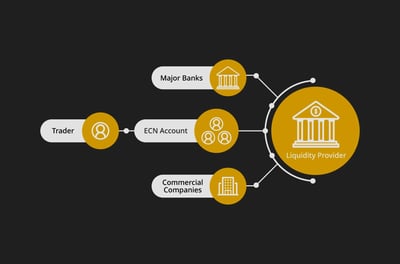
The ECN network works by directly matching buy and sell orders from market participants in real time. It creates a dynamic market where buyers and sellers can interact through rapidly shared information. This automated process helps finalize orders efficiently across the exchange.
ECN trading offers liquidity through a network. Therefore, information on active bids and offers is available in a bustling electronic marketplace. The system was designed to be more efficient and streamlined than traditional counterparty trading and is, therefore, characterized by tight spreads, sometimes as narrow as 0.0 pips.
What Is the Difference Between an ECN and a Standard Account?
The main difference between an ECN account and a standard account is how trades are executed and priced. An ECN account connects traders more directly to market liquidity, while a standard account usually routes trades through the broker as the counterparty. This affects spreads, commissions, and the overall trading experience.
ECN trades are executed when the broker connects the trader directly to liquidity providers. This is a non-dealing desk model.
Standard account trades are filled from within the broker’s partner pool, rendering this a market-making model.
ECN accounts simply match orders and charge a commission per trade for the service. ECN accounts do not place a premium on the raw spread, which can be as tight as 0.0 pips.
By contrast, standard trading accounts apply premiums to the raw spreads as their primary revenue line. As a Standard Account holder, it is widespread practice for you to pay a two-pip spread on most currency pairs. As the counterparty to your transaction, the broker needs to make money from the trade.
ECN accounts often come with a lower effective fee than standard accounts. The fee structure section below shows how this works out.
What Are the Pros and Cons of an ECN Account?
The pros and cons of an ECN account depend mainly on its pricing, execution speed, and trading conditions. It can offer lower spreads and faster access to market liquidity, but traders also need to consider commissions and the demands of a more professional-style setup. These factors shape whether this account type fits your needs.
ECN Account Pros
Tighter spreads. ECN accounts pass on the raw spreads quoted by liquidity providers, which can be as tight as 0.0 pips on major pairs in normal market conditions.
Faster execution. Orders are matched electronically with liquidity providers without a dealing desk, which is why scalpers and day traders favor this account type.
Market depth and transparency. Traders see bid and ask prices from several liquidity providers, so there is ample information that allows them to spot trends in the market.
Less chance of price manipulation. Because the broker does not act as the counterparty and only earns a commission, it has no direct interest in whether your trade wins or loses.
Anonymity. Orders are matched within the network rather than against the broker’s own book.
Suits scalping and automated trading. ECN accounts generally allow strategies such as scalping and bot trading.
ECN Account Cons
ECN liquidity can sometimes run low. Often, when important economic news is about to break, traders will choose to hold off on trading. It could even be liquidity providers that throttle supply in anticipation of a rise in demand. This can cause trading lulls in which liquidity is scarce due to market dynamics.
Higher trading costs. ECN brokers typically charge commissions per trade, which can add up, especially for high-frequency traders. Unlike market makers who profit from spreads, ECN accounts rely on commissions, making trading more expensive in some cases.
Variable spreads. While ECN accounts offer tight spreads, they fluctuate depending on market conditions. During times of low liquidity, such as after market close or during economic events, spreads can widen significantly, increasing trading costs.
Slippage and market volatility – Because ECN accounts connect traders to live market prices, they are exposed to price gaps and slippage, particularly in fast-moving markets. This can lead to orders being executed at less favorable prices, impacting strategy effectiveness.
No guaranteed execution. Unlike dealing desk brokers that absorb some market fluctuations, ECN brokers only match buyers and sellers. This means that large orders may experience partial fills or execution delays if liquidity is insufficient.
Limited leverage and margin requirements. Some ECN brokers impose stricter margin requirements compared to standard retail accounts. Higher capital requirements may limit the ability of smaller traders to use leverage effectively.
Complex order execution. ECN accounts often require a more advanced understanding of order types, liquidity depth, and market execution. Traders may need to adjust their strategies to account for variable spreads, commissions, and execution speeds.
Inactivity fees. Some ECN brokers charge fees for accounts that remain inactive over a period of time, making them less suitable for casual or infrequent traders.
In practice, the biggest surprise for newer ECN users is usually not the commission, but how quickly a 0.1-pip to 0.3-pip spread can widen during major news releases or thin-liquidity periods, which is why execution quality should be judged across different market conditions rather than from the headline minimum spread alone.
What Are the Pros and Cons of a Standard Account?
The pros and cons of a standard account are mainly tied to simplicity, pricing, and how the broker handles trades. Standard accounts can be easier for newer traders to use because spreads are more predictable, but execution and costs may differ from an ECN account. These trade-offs affect how suitable the account is for your trading style.
Standard Account Pros
Standard accounts are easy to handle and the cost of execution, although a little higher than some traders prefer, comes with the benefit of predictability. Working with fixed spreads is unthinkable to some traders as it seems restrictive, but other traders, especially novices, sit on the other side of the fence and appreciate the predictability of fixed spreads.
Knowing that each trade will cost you two pips regardless of market conditions could work for traders in times of volatility. Knowing exactly what fees to expect makes it easier to plan. Swing traders enjoy this type of account.
A swing trader takes up longer positions, from a few days to several weeks. Their intention is to take advantage of currency swings driven by world events. By locking in the spread of two pips, they are in a better position to know when they can profitably call in the trade.
No commissions on trades. Standard accounts typically make money through spreads rather than commissions, meaning traders do not pay per-trade fees. This can be beneficial for those who trade less frequently.
Standard accounts are easier for beginners because order execution is simpler and costs are more predictable than with ECN accounts. Standard accounts are generally more user-friendly, with simpler order execution and lower technical complexity compared to ECN accounts, which require an understanding of variable spreads and liquidity depth.
Lower minimum deposit requirements. Many brokers offer standard accounts with lower entry barriers, making them more accessible to beginner traders who do not have large capital to start with.
No partial fills. Since market makers execute orders internally, orders are usually filled in full rather than partially, as can happen in an ECN environment, although re-quotes and slippage can still occur in fast markets.
Less slippage in low volatility conditions. While ECN accounts are subject to market-driven price changes, standard accounts may offer more stability in calmer market conditions, reducing unexpected price movements on small trades.
Standard Account Cons
If you are a frequent trader, you might be paying something like 1.3 pips extra per trade on a standard account versus an ECN account. This inflated cost of execution adds up in the long term.
Potential for broker manipulation. Because the broker acts as the counterparty in a dealing-desk model, this structure creates a conflict of interest, as the broker can profit when the trader loses.
Slower execution and re-quotes. Orders are processed by the broker rather than directly in the market, which can lead to slower execution speeds and re-quotes, particularly in volatile conditions.
Limited scalping and HFT options: Many brokers impose restrictions on scalping and automated trading, making standard accounts less suitable for traders who rely on rapid, short-term strategies.
No access to market depth or order book. Unlike ECN accounts that show real-time bid/ask prices from multiple liquidity providers, standard accounts do not offer market transparency, limiting a trader’s ability to gauge order flow.
Higher slippage during volatility. Since the broker controls pricing, traders may experience more slippage when executing orders during major news events or market turbulence.
How Does the Fee Structure of Each Account Work?
The fee structure of each account differs mainly in how trading costs are charged. A standard account usually appeals to newer traders because its spread is more predictable, which can make costs easier to follow while learning the market. By comparison, pricing in other account types may be structured differently.
Users of the ECN account, on the other hand, tend to be more advanced in their trading career. They will not settle for entry-level tools and are starting to hunger for a faster and more dynamic interface. They understand that their trades can be directly presented to institutional liquidity providers and they seek that level of market involvement.
This is an attractive proposition, but there is no such thing as a free lunch, as we all know. ECN brokers make their money from a commission of roughly $3.50 per side per standard lot (100,000 units of the base currency), a common level in the market. Therefore, on a round-turn lot (a complete transaction featuring both the buy and sell portions), ECN account holders would pay $7. Thus, when trading one standard lot, you pay:
With the ECN account, $7 per round turn, which equates to 0.7 pips on EUR/USD, where one pip is worth $10 per standard lot
With the standard account, the market standard spread of 2 pips, or $20 per standard lot on EUR/USD
Put another way, because the ECN account bears a commission of $3.50 per side, or $7 per round turn, it is the equivalent of a 0.7-pip spread on EUR/USD. The ECN account is cheaper as long as its raw spread plus the 0.7-pip commission stays below the standard account’s two-pip spread.
Remember, though, that this assumes an ECN spread of 0.0 pips. This is sometimes the case, but not nearly always. Consider that the tightest spreads can be found between dominant currencies with low volatility. As you begin to trade in minor and exotic pairs, you will see spreads widen to cater for volatility. It is the same scenario with ECN accounts. When using this account type, you will sometimes see spreads between selected currency pairs that are rather wide. This must be factored into the financial calculations.
For the most part, traders who are conscious of fees will compare the two accounts and reach the same conclusion: ECN trading can be more cost effective than a standard account.
If you are a trader who recognizes this and is ready to progress in your career, then you will likely graduate from a standard account to an ECN account before too long. Note that your trading plan when using a different type of account should be different. Also, now that you know what a significant impact the type of account has on your trading prospects, you can better gauge who are the best brokers out there. When comparing account pricing, look at the all-in trading cost across major pairs, minor pairs, and volatile sessions, because an ECN account that looks cheaper on EUR/USD at calm times may not remain cheaper once spread expansion is included.
Conclusion
ECN Account vs. Standard Account comes down to what matters most to you: lower fees and faster execution, or simplicity and comfort as you learn. ECN accounts tend to suit traders seeking a more professional environment, while standard accounts can be a practical starting point for newcomers.
Before choosing, evaluate your experience level, trading style, and cost sensitivity. The right account is the one that supports your strategy today while giving you room to grow tomorrow.
Recommended Brokers
FAQ
What is ECN trading?
ECN trading is trading through an electronic communications network (ECN) broker. This type of broker offers an order-matching execution service that is conducted over the broker’s electronic platform. The broker charges a commission per trade for the service.
How do ECN brokers operate?
An ECN broker offers a no-dealing desk execution model, where the broker facilitates a client trade by matching buyer and seller. ECN brokers are known for having no conflict of interest with their clients because they do not act as counterparties to the trade, and only take a commission for their work. The commission is relatively low and traders feel the system is fairer as they have sight of much more information related to their orders than they would with a standard account.
What is ECN pricing?
ECN pricing involves charging a fixed commission on trades. Standard accounts levy a premium on the spread, but ECN accounts do not, instead they concentrate on recouping a commission per trade.
What is standard account pricing?
Standard account pricing is when brokers widen the spread on a currency pair to ensure they get a cut of the transaction. It is sometimes thought that brokers have a conflict of interest in this scenario, because the broker acts as the counterparty to your trade and also sets the markup it adds to the spread.
What are the best features of an ECN account?
ECN accounts are known for their speed of execution, anonymity and price fairness. Many traders come to appreciate the ECN account even if they start out with a standard account. ECN accounts are known for their transparency as traders see the bid/ask prices directly, free of any intermediary involvement.
What is the difference between an ECN account and a standard account?
An ECN account routes orders directly to liquidity providers and usually charges a commission with raw, variable spreads. A standard account is broker-priced, often uses wider fixed or marked-up spreads, and is generally simpler for beginners.
What is an ECN account in forex trading?
An ECN account gives you access to a network where your orders are matched with banks, brokers, and other liquidity providers. Instead of earning mainly from spread markups, the broker typically charges a commission per trade.
What is a standard account in forex?
A standard account is a broker-managed setup where the broker acts as the counterparty or fills orders through its own dealing structure. Costs are usually built into the spread, making fees more predictable but often higher over time.
Which is cheaper, an ECN account or a standard account?
ECN accounts can be cheaper overall when raw spreads stay low, even after adding commissions. Standard accounts may cost more per trade because the spread is usually wider, though they can feel easier to budget for.
Is an ECN account better for beginners?
Not always. Beginners often prefer standard accounts because pricing is easier to understand and execution is simpler. ECN accounts can still work for new traders, but they require more comfort with commissions, variable spreads, and slippage.
What are the main drawbacks of an ECN account?
The main downsides are commission charges, variable spreads, and more complex execution. In fast or thin markets, spreads can widen, slippage can increase, and large orders may not always be filled as smoothly as expected.
Who should choose an ECN account?
ECN accounts suit active traders who want tighter spreads, faster execution, and direct market access. They are especially appealing to scalpers, day traders, and experienced traders who care about execution quality and lower effective costs.
Who should choose a standard account?
A standard account is often better for newer or less frequent traders who value simple pricing and predictable costs. It can also suit swing traders who prefer a straightforward setup over the speed and complexity of ECN execution.
Do ECN accounts have fixed or variable spreads?
ECN accounts usually have variable spreads because prices come from live liquidity providers. These spreads can be extremely tight in normal conditions, but they may widen during major news events or when market liquidity drops.
Can you switch from a standard account to an ECN account later?
Yes, many brokers let traders switch if both account types are available. This is common when a trader starts with a standard account for simplicity and later moves to ECN trading for tighter spreads and faster execution.

Marwan A. Kardoosh is an economist and content writer at Arincen with over 25 years of experience in the MENA region. A Brunel University London economics graduate, he has worked with the IMF, World Bank, OECD, and UN agencies, and won the Economic Research Forum's prize for Best Policy-Oriented Research.


Related Articles
 FOREX Brokers
7 Best ECN Brokers for 2026
Trying to find the best ECN broker? Read our full review, methodology, and how to choose the best ECN brokers, as prepared by a seasoned team of Arincen experts.
 Trading Beginners
8 Best Indicators for Swing Trading and How to Use Them
Swing trading could be very profitable, but to take advantage of that fully, you must learn how to use the top indicators. Here is the explanation for the top 8 such indicators.