Table Of Contents
- What Is Electronic Trading?
- How Did Online Trading Begin?
- What Are Online Trading Platforms?
- How Does Online Trading Actually Work?
- What Rules Govern Online Trading?
- How to Trade Online
- How Can You Start Trading Over the Internet?
- What Are CFDs?
- What Is FOREX Trading?
- What Is Cryptocurrency Trading?
- What Is Stocks Trading?
- What Are ETFs?
- What Are Binary Options?
- Futures Contracts
- Metals Trading
- What Is Agriculture, Oil, and Gas Trading?
- What Are the Pros and Cons of Online Trading?
- Can Anyone Become a Successful Online Trader?
- How Arincen Supports Smarter Online Investing
- Conclusion
Electronic Trading Over The Internet
Electronic trading over the internet has transformed investing from an exclusive activity into something far more accessible to everyday people. What once required exchange-floor access, special permissions, and significant effort can now begin with an internet connection and the best broker you can find.
In this article, you will learn what online trading is, how it became widely available, and why so many people now treat it as either a hobby or a full-time occupation. If you have ever wondered how simple it is to become a trader, this guide will clarify the basics.
Online trading allows anyone with a computer and internet connection to access global markets that were once limited to licensed professionals.
A reliable online trading platform offers real-time prices, order execution, stop-loss features, technical indicators, and full customer support.
Trading over the internet still requires a broker who provides the software to execute deals, but the process is now nearly instant compared to pre-internet days.
Popular asset classes available for online trading include FOREX pairs, CFDs, cryptocurrencies, stocks, ETFs, futures, metals, and agricultural or energy commodities.
FOREX is the most liquid market in the world with $7 trillion traded daily, offering leveraged opportunities but also carrying high risk.
Cryptocurrency trading is extremely volatile and fast-moving, while ETF investing and stock CFDs offer more stable alternatives for long-term investors or speculators.
Binary options and futures contracts are more speculative and carry risks of total capital loss, especially for traders who do not follow market movements closely.
Arincen supports new and seasoned traders by offering daily analysis, social recommendations, expert strategies, and account-opening services through reputable broker partnerships.
What Is Electronic Trading?
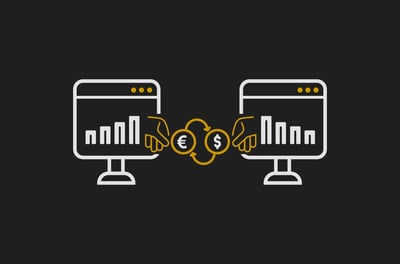
FOREX currency pairs are arguably the most traded class of financial assets, and the FOREX market is by far the world’s largest financial market at some $7 trillion in daily trading. FOREX trading is all about buying and selling currencies in pairs, in an attempt to realize a profit off the fluctuations between currency strength. This means you might buy a currency pair when the spread is at a certain level in anticipation of that spread widening due to a forthcoming market event. When you can sell your pairs at a wider spread than you bought them, you have successfully created a profit off their fluctuation. This difference between spreads is expressed in pips. We've written a detailed article about pips here.
Some traders choose rather “stable” currency pairs such as USD/EUR, also known as majors, in a bid to accumulate conservative repeated profits, others pick exotic currency duos that promise larger profits. Needless to say, with larger profits come higher risks.
How Did Online Trading Begin?
Online trading began with investors placing orders through brokerage firms, but it evolved as the web made direct execution possible. Improved security and internet access allowed traders to place deals themselves instead of calling a broker for each transaction. Today, brokers support this process with online platforms such as Metatrader, making trading faster and cheaper.
Brokerage firms make that process easier and cheaper, and they, in turn, offer convenient online trading platforms to their clients, the most famous of which is Metatrader.
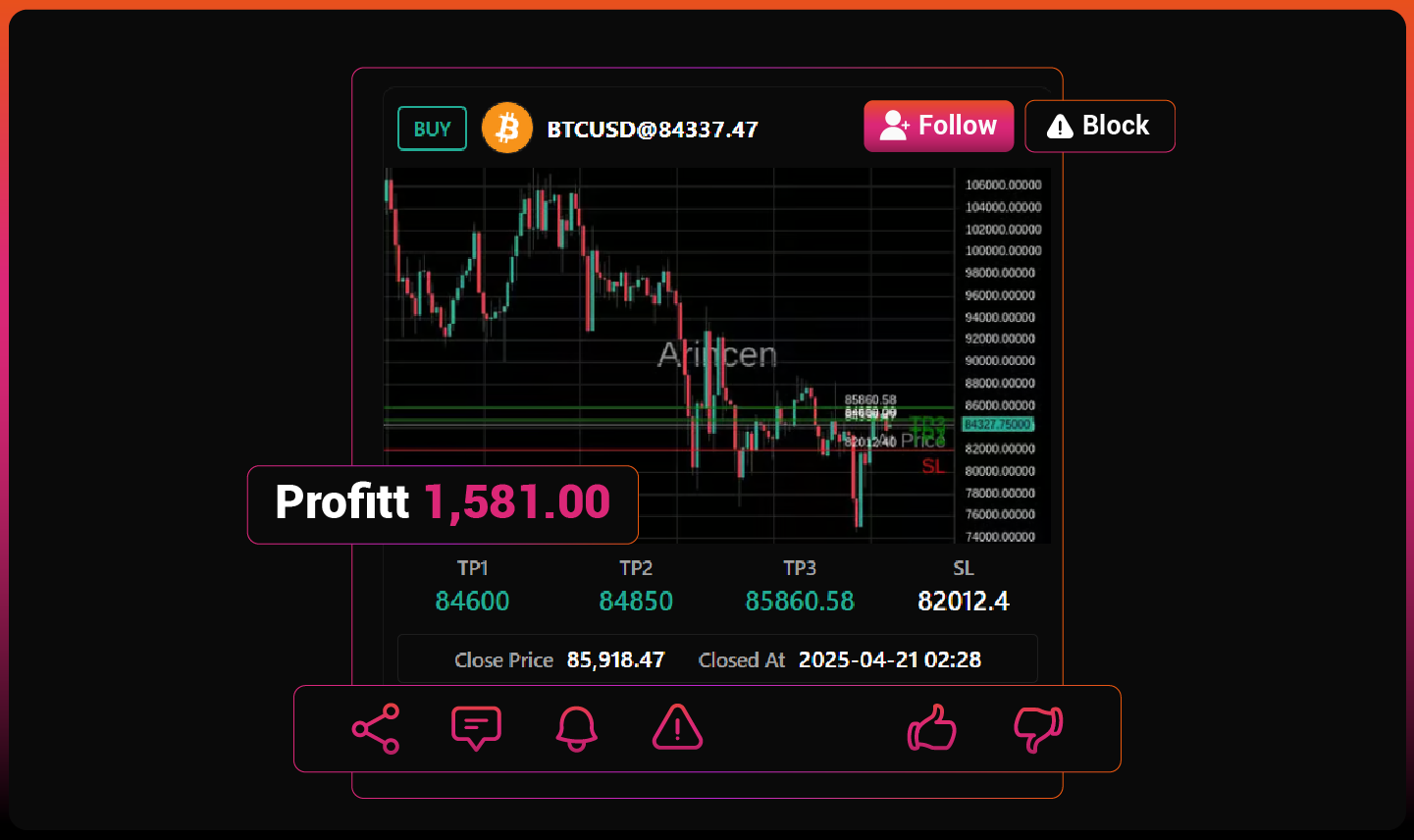
Trade with Real-Time Expert Signals
Follow live signals from experienced traders.
Get entry price, TP levels, SL, and closure updates.
Receive instant alerts when targets or stops are hit.
Track performance with clear, transparent stats.
Stay aligned with the market in real time.
What Are Online Trading Platforms?
Thanks to online trading, investors can follow markets in real time and place “buy”, “sell”, and “stop-loss” orders, which instruct a broker to sell a security at a particular price.
We can, therefore, make the assertion that the Internet has really changed the way financial assets are traded, by saving on time, cutting costs, and making the experience smoother overall.
Online trading gave traders from across the world the opportunity to enter financial markets and trade a range of asset classes.
Traditional currencies
Cryptocurrencies
Oil
Gold
Other classes of assets
Further, trading is available 24 hours, five days a week. All you need is a personal computer and Internet access.
In our reviews of online trading platforms over the past 12 months, we have found that execution tools, order types, and risk controls can differ meaningfully from one broker to another, which is why platform quality matters just as much as market access.
Recommended Brokers



How Does Online Trading Actually Work?
Despite the fact that online trading allows users to strike deals instantly, one thing remains the same: a private trader would still need a broker to be able to trade. For his part, the broker provides the trader with his trading platform – the software that the trader will be using to help clinch the deal. Most of the work nowadays is done by, and on, that trading platform.
This contrasts with the pre-Internet era, when the process was lengthy, requiring the trader to call the broker to open the deal and the broker to find a counterparty on the stock exchange.
What Rules Govern Online Trading?
Online trading is governed mainly by the forces of supply and demand, which influence asset prices across markets, including FOREX. When supply rises without matching demand, prices tend to fall, while stronger demand can push prices higher. Political and economic news also affects sentiment and confidence, leading traders to buy or sell and causing price movements.
How to Trade Online
The guiding principle to any online trading activity is to buy an asset, wait for its price to rise, and then sell it to profit from the price appreciation.
The bourse, simply put, is a market like any market, where there is a commercial exchange. That is to say, buying and selling. Capital markets differ depending on the assets that are being bought and sold. For example, there is a market for stocks. There is another for gold, metals, cryptocurrencies (such as Bitcoin) and FOREX, etc.
How Can You Start Trading Over the Internet?
You can start trading over the internet by opening an account with reputable trading companies through the Arincen Website. A staff member can guide you step by step through the process and support you as you work toward your goals. More details about these services appear later in the article.
What Are CFDs?
A Contract for Difference, or CFD, is a financial derivative in which the difference between the opening and closing trade prices is cash-settled. There is no delivery of physical goods or securities with CFDs. For example, if you anticipate the price of gold will rise against the US dollar, then you will buy gold and sell USDs, at a fixed price. While you would not physically “own” gold, you would have nonetheless opened a position between you and your CFD broker in which you speculated that the price of gold will rise in your favor. Should you see the price of gold rise vis-à-vis the USD, then you will offer your contract for sale. Again, the net difference of the gain or loss will be cash-settled through your account.
CFDs are popular among traders because they are often traded on margin. This means the brokerage firm lets investors borrow money to increase leverage and position size in pursuit of bigger profits. It also means you can start trading with a relatively small sum, but leverage and margin are risky because losses can be magnified by the amount of leverage you use.
In practice, we see that many new traders underestimate how quickly losses can build during high-volatility events, especially when leveraged CFD positions are left open around major economic releases.
What Is FOREX Trading?
FOREX is the marketplace where various national currencies are traded. When trading currencies, they are listed in pairs, such as the EUR/USD or the USD/JPY. These represent the Euro (EUR) versus the American USD and the American USD versus the Japanese Yen (JPY), respectively.
What moves the FOREX market are the forces of supply and demand. Though there are hundreds of currencies to be traded globally, according to the laws of international supply and demand, the most important currencies are:
The US dollar (USD).
The Euro (EUR).
The British Pound (GBP).
The Japanese Yen (JPY).
The Swiss Franc (CHF).
Take, for example, the USD/EUR pair. You cannot say that the price of the USD is “3.” Instead, you must say that the price of one USD is 3 Euros.
The most common major currency pairs in the FOREX market include, but are not limited to:
One of the most important features that distinguish the FOREX market from all other financial markets is margin trading. In FOREX, margin is a core feature that lets traders control larger currency positions with a smaller upfront deposit. In effect, margin allows traders to open leveraged trading positions, giving them more exposure to the markets with a smaller initial capital outlay. Of course, as we have said, margin trading can be a double-edged sword. It magnifies both profits and losses, for these are based on the full value of the trade, not just the amount required to open it.
What Is Cryptocurrency Trading?
Cryptocurrency trading involves buying and selling digital currencies that exist only in electronic form. These currencies may be described as digital money, electronic currency, or cyber cash. Examples include cryptocurrencies, virtual currencies, central bank digital currencies, and e-Cash.
Examples of digital currencies include:
Cryptocurrencies
Virtual currencies
Central bank digital currencies
e-Cash
Even though digital currencies exhibit properties similar to other, more traditional currencies, they do not have a physical form of banknotes and coins. Therefore, they allow for nearly instantaneous transactions.
Bitcoin, considered by many as a trailblazer in the world of cryptocurrencies, has ushered in a wave of over 9,000 cryptocurrencies and counting built on a decentralized peer-to-peer network.
Chief among these are:
Ethereum
Bitcoin Cash
Ripple
Litecoin
In contrast to stock market trading (discussed below), cryptocurrencies are far more volatile. Indeed, a 300% monthly rise followed by a 30% daily drop is considered quite normal for cryptocurrencies. For this reason, you need to develop a robust crypto trading strategy.
What Is Stocks Trading?
Stock markets are the markets and exchanges where shares of publicly held companies are bought, sold, and issued. Such activity occurs in central physical bourses that have opening and closing hours. Among the most famous exchanges are the New York Stock Exchange and the NASDAQ, which are both located in the Big Apple.
The buying and selling of stocks through CFDs allow traders to buy and sell shares in international companies listed in New York, on the NASDAQ, and on the London Stock Exchange, among others, without any fees or restrictions. As you already know, with CFDs, you don't get to own the underlying asset, which you can do with stocks, but many good stock brokers offer you direct ownership of company shares if you prefer that model.
There are two types of stock market traders: A “speculator,” who gets into the market looking for short-term gain. They buy and sell quickly, as soon as there is a profit opportunity. By sharp contrast is the “investor,” who buys shares in a company and is looking to invest money into that business. Such investors are in the market for the long term. Their expected returns come from increases in the stock price, as well as from the annual dividend that the company ends up paying.
What Are ETFs?
ETFs are funds designed to track a benchmark index or group of assets, giving investors broad market exposure at relatively low cost. Index ETFs, in particular, aim to replicate benchmarks such as the Dow Jones Industrial Average, Nasdaq 100, or the S&P 500. They have become increasingly popular because they offer diversified, passive investment strategies.
What Are Binary Options?
A binary option is a financial instrument that allows traders to bet on how the price of an asset would change within a specific amount of time. In a standard binary option, there are three parameters to bear in mind:
The direction of a price change (up/down).
The expiration date.
The Transaction volume (rate).
Binary options are attractive and risky at the same time. They allow for a big profit, even if the price changes are not that large. The only thing the trader needs is for the price to change at least one point in the specified direction and to continue holding it there until the expiration date. In this case, the trader will get 80-90% of his bid. By the same token, if the price goes in the wrong direction, even if by a single point, the trader will lose his bid. Let’s give an example to illustrate how a binary option actually works.
Assume a trader has starting capital of $1,000 and is interested in opening an option for EUR/USD with the following parameters:
Direction – Up.
Period – 5 minutes.
Rate – $100.
Depending on the conditions the broker has set, if the price goes up by just one point during these five minutes, the trader will get $80-90 dollars in profits. However, if the price goes in the other direction, the trader will lose $100.
Futures Contracts
A futures contract is defined as “a legal agreement to buy or sell a particular commodity asset, or security at a predetermined price at a specified time in the future.” No direct exchange of “goods or money” takes place. The buyer of a futures contract is taking on the obligation to buy the underlying asset when the futures contract expires. Meanwhile, the seller of the futures contract is taking on the obligation to provide the underlying asset at the expiration date. However, in reality, the buyer doesn’t usually need the actual commodities. Instead, he needs the “right” to them so that he can make a speculative profit from trading this product. The buyer is thus able to sell futures to other traders.
Metals Trading
Metals trading typically involves gold and silver, and other metals such as platinum. Other metals that can be bought and sold on the FOREX market include copper, nickel and aluminum, just to name a few. It is thought that metals trading is closely linked to the outlook for the overall global economy, as well as to the sentiment surrounding major currencies. Gold, in particular, is known as a safe haven asset, which is why there will always be interest in this commodity when the fiat currency economy is volatile.
What Is Agriculture, Oil, and Gas Trading?
Metals aside, commodity trading covers several other areas.
Agriculture sector (e.g., wheat)
Hydrocarbon industry (e.g., oil and gas)
Popular metals such as gold and silver
Soft commodities, which are typically food items like coffee
These have their own clientele and rank in straight after trading activity in general currency pairs. When we speak of commodity trading, the truth is that you can invest in a wide range of commodities.
What Are the Pros and Cons of Online Trading?
Online trading offers major advantages in speed and access, but it also comes with important risks and drawbacks. It has changed how investors exchange assets by making participation easier and more immediate. At the same time, traders still need to weigh the potential benefits against the possible disadvantages.
On the positive side of the equation:
online trading offers the possibility of vast profits
it is also convenient in that you can set your own hours and trading location
you can start trading while continuing to do your regular nine-to-five job
there is no pre-set minimum, meaning you can start trading with what you can afford
On the negative side of the equation:
there are relatively high risks associated with financial trading
you could lose money through bad trading decisions
there is a small risk you could be scammed
Can Anyone Become a Successful Online Trader?
Know your market and pick the types of assets you want to invest in.
You can start by adopting someone else’s already-proven strategy through signals or copy trading
Achieve trading independence by understanding the market and creating your own methods
Start small or, even better, begin trading with a demo account
Only switch to a real account when your demo portfolio is starting to turn in handsome profits
Market Participants: Who Uses Electronic Trading
How Arincen Supports Smarter Online Investing
Arincen is an investment community platform built to help investors turn market complexity into clearer, smarter decisions. Rather than acting as a broker, Arincen gives users access to the data, tools, and community support they need to grow with confidence across diverse investment opportunities, with a strong focus on stocks and crypto.
Community: Follow experienced traders, share ideas, and engage with other investors in one place.
Signals and Statistics: View expert trade ideas with clear entry, target, and stop-loss levels, alongside transparent performance data.
Tools: Use watchlists, charting, portfolio tracking, market news, and AI-powered assistance to analyse instruments and stay ready to act.
At its core, Arincen exists to make investing more accessible, more transparent, and more informed — because smarter decisions are made together.
Conclusion
Electronic trading over the internet offers accessibility, opportunity, and the potential for financial growth, but it also demands patience, discipline, and a clear understanding of risk. Success does not come from reacting emotionally, but from staying calm, learning continuously, and making informed decisions in both rising and falling markets.
If you want to get started, take time to understand the basics, choose the best broker carefully, and approach every trade with caution. The more prepared you are, the better your chances of building lasting trading habits.
Recommended Brokers
FAQ
What is electronic trading over the internet?
Electronic trading is the buying and selling of financial assets through internet-based platforms provided by brokers. It lets traders access markets, place orders, and manage positions remotely instead of trading on a physical exchange floor.
What can you trade online?
You can trade many asset classes online, including FOREX pairs, stocks, commodities, indices, cryptocurrencies, metals, and CFDs. The exact range depends on the broker and the platform you use.
Do you need a broker to trade online?
Yes, retail traders usually need a broker to access online markets. The broker provides the trading platform, connects your orders to the market, and may also offer support, tools, and account services.
How do online trading platforms work?
Online trading platforms let you open, close, and monitor trades from your computer or phone. They also provide price charts, market data, and order tools such as buy, sell, and stop-loss functions.
How much money do you need to start online trading?
You can often start with a relatively small amount, especially when trading CFDs or margin products. Still, you should only use money you can afford to lose and begin small or with a demo account first.
Is online trading profitable?
Online trading can be profitable, but it is not easy or guaranteed. Returns depend on your strategy, discipline, market knowledge, and risk management, while losses can happen just as quickly as gains.
What are the main risks of online trading?
The main risks include losing money through poor decisions, high market volatility, and the amplified danger of leverage and margin. There is also a smaller but real risk of dealing with unreliable brokers.
What is the difference between online trading and traditional trading?
Traditional trading often required direct communication with a broker and activity on physical exchanges. Online trading is faster, cheaper, and more convenient because investors can execute trades themselves through digital platforms.
Can beginners start with a demo account?
Yes, a demo account is one of the best ways for beginners to start. It allows you to practice using the platform and test strategies without risking real money before moving to a live account.
What affects prices in online trading markets?
Prices are mainly driven by supply and demand, but political and economic news also plays a major role. Changes in sentiment, confidence, and expectations can quickly move currencies, stocks, commodities, and other assets.


Marwan A. Kardoosh is an economist and content writer at Arincen with over 25 years of experience in the MENA region. A Brunel University London economics graduate, he has worked with the IMF, World Bank, OECD, and UN agencies, and won the Economic Research Forum's prize for Best Policy-Oriented Research.

Related Articles
 Crypto
What is Cryptocurrency?
Cryptocurrency is defined as a digital currency designed to work as a medium of exchange. How does it work and what is blockchain? All in this comprehensive guide.
 Trading Beginners
What is Leverage in Trading?
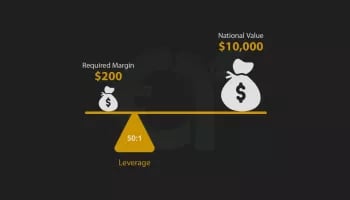
Leverage allows the trader to take on a greater position using borrowed capital. However, it comes with its own risks. Read all about it before using it.
 Trading Beginners
What is Social Trading, Best Social Trading Brokers
This important article introduces you to social trading. Find out about social trading and related concepts, like copy trading. Learn about the best social and copy brokers.