Table Of Contents
- What is Online Trading?
- How does online trading work?
- What are the types of online trading risks?
- What are the main risks of online trading?
- How can you hedge the risks of online trading?
- How can you protect your account against online trading risks?
- What are the pros and cons of online trading?
- How can you overcome the risks of online trading?
- The Bottom Line
The Top 10 Risks of Online Trading: What Every Investor Should Know
As a seasoned trader, I've seen enough to know that online trading was not always this prevalent. It is so active today in part because it has never been safer. Traders have a wealth of information at their fingertips to guide their decisions in the trading world. In fact, there is an arms race among trading brokers to see who can provide the most information-rich, user-friendly, and informative services. A broker without a powerful, well-resourced research and education section can consider itself behind the pack. So, why is trading still risky? For the answer, traders must look within. Many of the risks related to online trading come from human behavior, including making emotive decisions based on human psychology, buying into the hype, and not being sufficiently well-researched. There are many more reasons for online trading, as I will examine in this article. Before I go on, I should point out that online trading can be entirely safe and richly rewarding. Still, this article covers the eventualities that all traders must be aware of to keep their trading journey as safe as possible.
Online trading is fast and accessible but carries real risks from market volatility, tech failures and fraud
Market risk is unavoidable, so traders must be prepared for gains and losses in any asset class
Leverage can magnify both profits and losses and easily lead to margin calls if used carelessly
Failing to use stop-loss orders can leave your trades exposed to unlimited downside risk
Technical glitches and internet outages can prevent you from acting quickly when the market moves
Fraudulent brokers and scam platforms are a major threat, so always check regulation and licenses
Hedging strategies like diversification and trading smaller positions help limit overall exposure
Emotional trading driven by fear or greed leads to impulsive decisions that often end badly
What is Online Trading?
Online trading, as you will probably already know if you are reading this article, is the process of buying and selling financial assets, such as stocks, bonds, commodities, and currencies, through the internet-based platforms of trading brokers.
Instead of using old-style brokerage firms, where you would need to call a broker to execute trades on your behalf, online trading allows you to manage your investments independently, right from your computer or smartphone.
It’s big business, and these platforms provide access to a wide range of financial markets and allow investors to execute trades in real-time, often with lower fees than traditional brokerage services. Whether you're looking to invest for the long term or engage in short-term trading, online platforms make it easier for you to enter the world of finance.
However, with ease of access also comes risk, and it's important to grasp both the benefits and the challenges of trading online.
How does online trading work?
Online trading works through electronic platforms that connect individual investors to financial markets and let them buy or sell assets online. After signing up with a trading platform or brokerage, you can access markets such as stocks, FOREX, commodities, and cryptocurrencies. The platform serves as the intermediary, making it possible to execute trades quickly with just a few clicks.
You may already know this, but to get started, you deposit funds into your account, which you can then use to execute trades. Most platforms offer tools and charts to help you analyze the market, track price movements, and make informed decisions through technical analysis.
When you're ready to place a trade, you choose the asset you want to buy or sell, enter the number of shares or units, and confirm the order. Depending on your trading strategy, you can place orders for immediate execution or set conditions like limit orders, where the trade only happens if the asset reaches a certain price.
Once your trade is executed, the platform will update your account balance and holdings in real time. The ease and speed of online trading are appealing, but this convenience can also lead to impulsive decisions. That’s why understanding how the platform works and being aware of market dynamics is crucial before diving in.
Trade with Real-Time Expert Signals
Follow live signals from experienced traders.
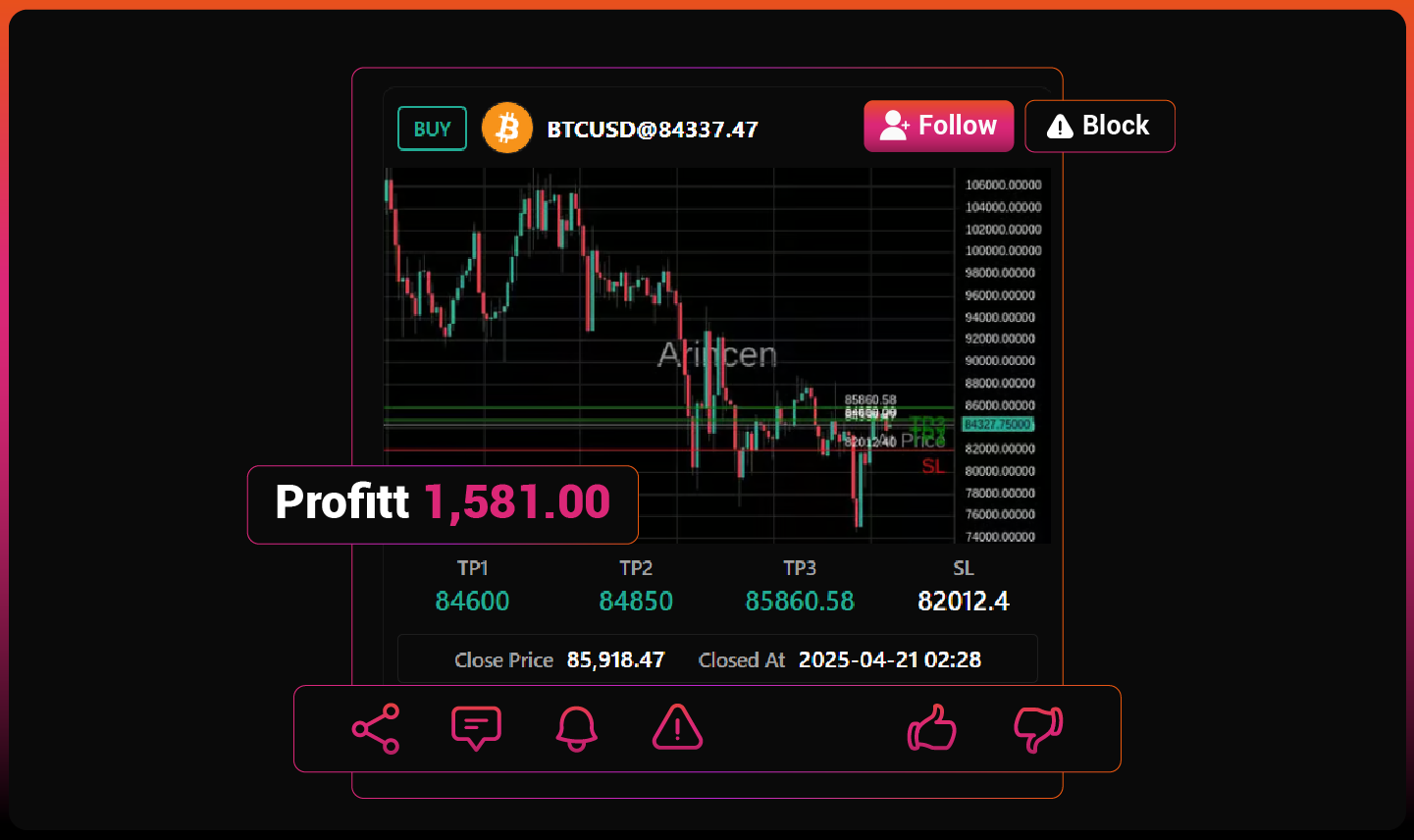
Get entry price, TP levels, SL, and closure updates.
Receive instant alerts when targets or stops are hit.
Track performance with clear, transparent stats.
Stay aligned with the market in real time.
What are the types of online trading risks?
Online trading risks include market volatility, security threats, and other pitfalls that can lead to losses if they are not managed properly. These risks can affect both new and experienced traders across different markets. Understanding the main categories of risk makes it easier to avoid costly mistakes.
Market risk
This one is inescapable. Market risk refers to the potential for losing money due to changes in the financial markets. It’s the nature of the beast. When you engage in online trading, the value of the assets in which you invest—whether stocks, currencies, or commodities—can fluctuate based on market conditions, such as economic news, geopolitical events, or shifts in investor sentiment.
These price swings can lead to significant gains but can also result in substantial losses. Market risk is unavoidable in trading, as no one can predict the exact direction of prices, making it essential for traders like you to be ready for both ups and downs.
Technical risks
Technical risks are all about the technology and systems that support online trading. Since trading platforms are digital, any disruption—such as server outages, software bugs, or internet connectivity issues—can interfere with your ability to execute trades or monitor the market.
Think about it, you might experience a delay in executing a trade during a crucial moment, leading to missed opportunities or losses. Also, relying on automated systems or algorithms can sometimes result in unintended outcomes, particularly if the system experiences a glitch.
In our review of broker platforms over the past 12 months, we found that execution delays and temporary outages were most damaging during high-volatility events, when even a few seconds could materially affect entry and exit prices.
Fraud risks
As long as there is a financial ecosystem and the possibility of making money from it, there will be fraud risks.
This involves the potential for falling victim to scams or unethical practices in the online trading world.
With the rise of internet-based trading platforms, fraudulent schemes have become more common, including fake platforms, phishing attacks, or Ponzi schemes that promise unrealistic returns. Scammers may pose as legitimate brokers or offer "get rich quick" trading opportunities to lure unsuspecting traders. If you're not cautious, you could end up investing in fraudulent assets or losing your money entirely to dishonest actors.
What are the main risks of online trading?
The main risks of online trading are the practical situations that arise from issues such as market risk, fraud, and poor trading decisions. These risks can appear in different ways depending on the asset, platform, and market conditions. Looking at specific examples helps clarify how they affect traders in real situations.
1. Losing more money than you put up
In online trading, especially with leveraged instruments like CFDs or options, you can lose more money than you initially invested. This happens when the market moves quickly against your position, and your losses are more than the funds in your trading account, leading to significant financial damage.
2. Leverage and increased appetite for risk
Leverage allows you to control larger positions with a small amount of capital, amplifying both gains and losses. While leverage can lead to higher profits, it also increases the risk of losing significant amounts of money quickly, especially if you become overconfident and take on more risk than you can handle.
3. Margin call
A margin call is bad news for traders. It happens when the value of your account falls below the minimum margin requirement set by your broker. When this occurs, your broker may “call” on you to deposit more funds or close positions to bring the account back to the required level. If you can’t meet the margin call, your positions could be liquidated at a loss.
4. Internet outage
Sometimes it’s the simplest things. Online trading relies on stable internet access, and an outage at the wrong moment can stop you from placing, adjusting, or closing trades. This could result in significant losses, especially during periods of market volatility when you need to be acting quickly.
5. Risk of fraud by unlicensed brokers
Unlicensed or unregulated brokers are a significant risk in online trading. These brokers may not act under the control of a regulator and may not follow standard financial regulations, which means they can manipulate trades, charge hidden fees, or simply disappear with your funds. I can’t say it enough—always trade only with brokers licensed by reputable regulatory bodies.
6. Opening positions larger than the account can handle
Opening positions that are too large for your account increases the likelihood of losing your capital quickly. I get it; leverage seems like a sweet deal, but a single large market move can wipe out a substantial portion of your account, or worse, put you in debt due to the size of the positions relative to your available funds.
7. Long-term decline in traded assets
Investing in assets that experience a long-term decline can erode your capital over time. Holding onto a losing trade with the hope of a reversal, rather than cutting losses, can lead to even larger losses as the asset’s value continues to drop.
8. News of violent market movements
Sudden market movements triggered by unexpected news events—such as geopolitical tensions, economic reports, or natural disasters—can cause significant volatility. Just look at the impact on the financial markets of events like the financial crisis and Russia’s invasion of Ukraine. Traders who are unprepared for these rapid shifts can experience large, sudden losses as markets react swiftly to new information. You should always monitor your broker's newsfeed for significant news.
9. Not using stop loss
Failing to use a stop-loss order is one of the riskiest trading practices. Without a stop loss in place, you’re exposed to unlimited downside risk, as there is no automated trigger to close your position if the market moves against you. This can lead to much larger losses than anticipated.
10. Using stop loss
While stop-loss orders are designed to limit losses, they can also be risky in volatile markets. If the price of an asset fluctuates dramatically, a stop-loss order may be triggered prematurely, closing your position at an unfavorable price. This is known as "stop hunting" and can lead to losing out on a potential recovery in asset prices. You have to be careful of both sides of a stop-loss going against you.
In practice, the biggest problems we see with leverage are not usually technical, but behavioral: newer traders tend to increase position size after a short run of wins, and that pattern often leads to outsized losses during the next volatile session.
How can you hedge the risks of online trading?
You can hedge the risks of online trading by using risk management strategies that protect investments and reduce potential losses. These methods help limit exposure when markets move unexpectedly or trades do not go as planned. Using clear hedging techniques can make trading decisions more disciplined and more consistent over time.
1. Use stop-loss orders
We’ve already touched on this, but a stop-loss order is an essential tool that automatically closes your position when an asset hits a predetermined price. This limits the amount of loss you can incur if the market moves against you.
By using a stop-loss order, you can set a clear boundary for losses and prevent emotions from driving you to hold a losing position for too long.
2. Diversify your portfolio
Diversification involves spreading your investments across different asset classes, sectors, or geographic regions to reduce exposure to any single risk. By holding a diversified portfolio, you reduce the impact that poor performance in one area can have on your overall investments. It’s a common sense approach. If one sector suffers a downturn, gains in another sector can offset the losses, reducing the overall risk.
3. Use hedging strategies
Hedging involves taking an opposite position in a related asset to offset potential losses. For example, if you’re heavily invested in a stock and fear a market downturn, you can hedge by buying put options on that stock. Put options give you the right to sell the stock at a certain price, helping protect you from large losses if the stock’s value drops.
4. Trade smaller positions
Rather than risking large amounts of capital in a single trade, consider taking smaller positions. This way, even if the market moves against you, your losses will be limited. Trading smaller positions reduces the potential damage from volatility, particularly in the highly speculative sectors of online trading.
5. Monitor leverage and margin use
While leverage can amplify gains, it can also magnify losses. To hedge against risk, it’s crucial to use leverage responsibly. Avoid overleveraging by maintaining a comfortable margin level and being mindful of how much capital is at risk. By using leverage conservatively, you can avoid the pitfalls of margin calls or large losses that exceed your initial investment.
6. Stay informed and use fundamental analysis
You can never be too informed! Understanding the underlying fundamentals of the assets you’re trading can help you anticipate risks and opportunities. By conducting regular research and staying updated on market news, economic reports, and geopolitical events, you can better predict market movements. Fundamental analysis allows you to make informed trading decisions and adjust your positions before unexpected volatility occurs.
7. Keep an emergency fund
It’s wise to keep an emergency fund outside of your trading account to cover unexpected market downturns or personal financial needs. Having a financial cushion can help you avoid selling assets at a loss during market dips and gives you more flexibility in your trading strategy.
8. Regularly review and adjust your strategy
The markets are constantly evolving, so your trading strategy needs to be adaptable. Regularly review your trades and assess your risk exposure. Adjusting your risk management plan, stop-loss levels, and diversification strategies based on market conditions helps ensure that your portfolio remains aligned with your risk tolerance.
How can you protect your account against online trading risks?
You can protect your account against online trading risks by using security measures that reduce the chance of unauthorized access and financial loss. Strong account protection is essential because trading platforms and digital transactions can be exposed to cyber threats. Taking preventive steps helps keep both your funds and personal information safer.
Choose reputable brokers and platforms
Based on our reviews of regulated and offshore brokers, one of the most effective ways to protect yourself in online trading is by selecting a reputable broker. Ensure that the platform is regulated by recognized financial authorities, such as the Cyprus Securities and Exchange Commission (CySEC) or the Financial Conduct Authority (FCA), to guarantee that your funds are secure and that the broker follows industry standards. Check reviews and user feedback to assess the reliability and safety of the platform.
Choose strong and unique passwords
If you are active in today’s digital world, this advice will not be new to you, but it never gets old. Always use strong, unique passwords for your online trading accounts. A strong password includes a mix of letters, numbers, and symbols, making it harder for hackers to guess.
Avoid reusing passwords from other accounts, and consider enabling two-factor authentication (2FA) for an added layer of security. This ensures that even if someone obtains your password, they would still need access to a second form of verification.
Update software and operating systems regularly
It may be a chore, but keeping your trading software, browsers, and operating systems updated is crucial to preventing cyberattacks. Software updates often include security patches that fix vulnerabilities exploited by hackers. Make sure your trading platform and any security tools are always running the latest versions.
Beware of scams
Online trading scams are becoming increasingly sophisticated, so it's important to be vigilant. Be cautious of unsolicited messages, emails, or phone calls that promise unrealistic returns or ask for personal information. Always verify the legitimacy of any communication from your broker, and never click on suspicious links or provide sensitive information without confirming the source.
Secure your device
Ensure your device is secure by using reliable antivirus software and firewalls. Avoid using public Wi-Fi networks for trading or accessing your accounts, as these are often unsecured and can expose your personal data to hackers. If you must trade while on the go, consider using a virtual private network (VPN) to encrypt your internet connection and protect your data. It takes extra steps to keep yourself safe, but the safety is worth it.
Diversify your investment portfolio
In my view, diversification not only mitigates financial risk but also adds an extra layer of protection against trading platform issues or individual asset volatility. Spread your investments across different asset classes, such as stocks, bonds, and commodities, to reduce the risk of significant losses if a single asset class underperforms.
Set stop loss and take profit orders
Setting stop-loss and take-profit orders helps you automate your trades and manage risk. A stop-loss order ensures that your position is closed automatically once a certain loss threshold is reached, protecting you from significant market drops. Similarly, a take-profit order locks in gains once a target price is hit, securing profits before a market reversal occurs.
Use leverage carefully
Leverage can amplify both gains and losses, making it a risky tool in online trading, especially when it tempts traders to take oversized positions. To protect your account, use leverage cautiously and avoid overleveraging, especially as a new trader. Alternatively, consider long-term investing without leverage, which can provide stable growth without exposing you to the heightened risks of short-term volatility.
What are the pros and cons of online trading?
The pros and cons of online trading include benefits such as convenience and market access, along with drawbacks such as risk exposure and the potential for costly mistakes. Understanding both sides helps traders make more balanced decisions. This comparison also shows why risk management is essential when trading online.
Pros
Convenience and accessibility
I have found that one of the biggest advantages of online trading is its accessibility. You can trade from anywhere, at any time, using a computer or mobile device. You can trade on your way to work, while waiting to fetch your kid, or from your couch late at night. This 24/7 access allows you to manage your investments with ease and flexibility, enabling you to react quickly to market changes.
Lower costs
Online trading platforms typically charge lower fees than traditional brokerage services. You can execute trades at reduced commissions or, in some cases, commission-free, making it more affordable, especially for retail investors. With lower transaction costs, more of your investment capital goes toward actual trades rather than fees. But, as with everything, you have to take the power into your own hands and conduct thorough research.
Real-time control
Online trading puts you in control of your investments. You can buy and sell assets instantly without relying on a broker, giving you the ability to make decisions in real time. This can be especially beneficial during periods of market volatility when quick action is essential.
Variety of investment options
With online trading, you have access to a wide range of financial instruments, including stocks, bonds, forex, commodities, ETFs, and cryptocurrencies. This variety allows traders to diversify their portfolios and explore different markets and asset classes from one platform.
Educational resources and tools
Many online trading platforms provide free educational resources, tools, and data to help traders make informed decisions. From charting software and technical analysis tools to market news and research reports, these resources empower investors to develop and implement trading strategies.
Cons
Increased risk of losses
While online trading offers easy access to financial markets, it also increases the risk of losses, particularly for inexperienced traders. The convenience of making quick trades can lead to impulsive decisions that fail to fully analyze the market. This "easy access" can sometimes encourage overtrading, leading to significant losses.
Emotional trading
Online trading can expose you to emotional decision-making. Seeing markets move in real time can create anxiety, leading to decisions driven by fear or greed rather than logic. This can result in buying high and selling low, which negatively impacts returns.
Technical issues and downtime
Online trading relies on technology, and technical issues such as platform outages, slow execution speeds, or internet failures can affect your ability to trade at critical moments, particularly during sharp price swings when timing matters most. A platform outage during a market crash or rally could prevent you from making timely decisions, leading to missed opportunities or losses.
Potential for overleveraging
Leverage, which allows you to trade with borrowed money, can significantly magnify both gains and losses. While it can be tempting to use leverage to increase profits, overleveraging in online trading can quickly lead to large debts if trades don’t go as planned, particularly in volatile markets.
Risk of scams and fraud
The rise of online trading has also led to an increase in fraudulent platforms and scams, so traders need to verify regulation, website authenticity, and withdrawal policies. Unregulated brokers, phishing attempts, and "get-rich-quick" schemes can pose a threat to your funds. It’s crucial to do thorough research and use licensed, reputable trading platforms to avoid falling victim to fraud.
How can you overcome the risks of online trading?
You can overcome the risks of online trading by building trading knowledge, following disciplined strategies, and using tools that reduce unnecessary losses. Education helps you understand how markets behave and how to respond to changing conditions. The more informed and prepared you are, the easier it becomes to manage risk effectively.
I would always caution new traders to educate themselves about how markets work, the assets they want to trade, and the risks involved. Many online platforms offer free educational resources, such as tutorials, webinars, and market analysis tools, which can help you develop a solid foundation. Knowledge is the best way to minimize risk, so understanding the basics is essential.
2. Start small and build gradually
If you're new to online trading, start with small investments. This approach allows you to learn and gain experience without risking large amounts of money. As you build confidence and refine your strategy, you can gradually increase your position sizes while keeping risk in check. Starting small also helps you become comfortable with the platform’s tools and features.
3. Use stop-loss and take-profit orders
A key way to manage risk is by setting stop-loss and take-profit orders on all trades. A stop-loss order automatically closes your position if the market moves against you, helping enforce discipline when markets move quickly. A take-profit order locks in profits once the asset reaches a target price. These automated tools help remove emotion from your decision-making process and ensure you stick to your risk management plan.
4. Diversify your portfolio
If you are a regular reader of these pages, you’ll have heard us say that diversification is one of the most effective ways to reduce risk in online trading. Instead of putting all your money into one asset or sector, spread your investments across different asset classes, industries, or geographic regions to improve portfolio resilience across market conditions. A well-diversified portfolio helps protect you from large losses if a single asset or sector performs poorly.
5. Avoid overleveraging
Leverage allows you to control large positions with a small amount of capital, but it also amplifies potential losses. To reduce risk, use leverage conservatively or avoid it altogether, especially if you're a beginner. Overleveraging can quickly lead to margin calls and large debts if the market moves against you. Always remember to track how much you’re risking relative to your account size.
6. Stay informed
Keeping up with market news, economic reports, and global events is critical to successful online trading. External factors, such as geopolitical events or interest rate changes, can significantly impact market movements. By staying informed, you can anticipate potential risks and adjust your trading strategy accordingly.
7. Develop a trading plan
A well-thought-out trading plan outlines your strategy, risk tolerance, and goals. It helps you stay focused and disciplined, especially during volatile market conditions. A good plan includes entry and exit points, position sizes, and stop-loss levels. Sticking to your plan can prevent impulsive decisions driven by emotions like fear or greed.
8. Choose a reputable broker
Only trade with licensed and regulated brokers to reduce fraud exposure, and review their fees, platform security, and complaint history before opening an account. Research brokers thoroughly to check their reputation, fees, and regulatory status. Make sure the platform provides adequate security measures, such as two-factor authentication, and that it complies with financial industry standards.
9. Monitor your trades
In my view as a trader, even if you use stop-loss or take-profit orders, it’s important to monitor your trades regularly. Markets can be volatile, and circumstances can change quickly. Regularly reviewing your positions allows you to make necessary adjustments, close trades early if needed, or seize new opportunities.
10. Stay calm and carry on! Avoid emotional trading
Online trading can be exciting, but it’s essential to stay calm and avoid making decisions based on emotions. Fear and greed are two common drivers of poor trading decisions. Stick to your trading plan and avoid chasing the market or making impulsive trades after a loss. Practicing patience and discipline will help you navigate market volatility more effectively.
The Bottom Line
Online trading risks are real, but they are far easier to manage when you approach the markets with discipline, research, and realistic expectations. From market volatility and impulsive decision-making to platform-related and knowledge-based mistakes, the biggest threats often come from acting too quickly or without a plan. The key takeaway is simple: learn how online trading works, use the tools your broker provides, and make decisions based on strategy rather than emotion. If you want your trading journey to be safer and more rewarding, start by improving your knowledge, managing your risk, and staying consistent every time you enter the market.
FAQ
What is online trading?
Online trading is buying and selling assets such as stocks, forex, commodities, and crypto through internet-based broker platforms. It gives you direct market access from your phone or computer, but convenience does not remove the risks.
What are the main risks associated with online trading?
The main risks are market volatility, technical failures, fraud, overleveraging, and emotional decision-making. Losses often happen when traders react impulsively, use too much leverage, or trade through unreliable platforms.
Can I lose more money than I initially invested?
Yes. If you trade leveraged products such as CFDs or options, losses can exceed your initial deposit when the market moves sharply against your position.
What is a margin call in online trading?
A margin call happens when your account falls below the broker’s required margin level. You may need to add funds or close trades, otherwise the broker can liquidate positions automatically.
How can I protect myself from online trading fraud?
Use only licensed, regulated brokers, verify their credentials, and ignore promises of guaranteed returns. Also avoid suspicious links, unsolicited messages, and requests for sensitive account details.
How do stop-loss orders help manage risk?
A stop-loss closes a trade automatically when price reaches a level you set. It helps cap losses and adds discipline, although volatile markets can still trigger it at an unfavorable moment.
What are some strategies to minimize risks in online trading?
Use smaller position sizes, diversify across assets, limit leverage, set stop-loss and take-profit orders, and review your strategy regularly. Staying informed and following a clear plan also reduces avoidable mistakes.
Why is emotional trading considered risky?
Emotional trading can push you to chase losses, exit too early, or enter bad trades out of fear or greed. A written plan and firm risk limits help keep decisions rational.
How much leverage should beginners use in online trading?
Beginners should use very little leverage or avoid it entirely at first. Lower leverage reduces the chance of rapid losses, margin calls, and oversized positions that your account cannot safely support.
Can technical issues affect my trades?
Yes. Platform outages, internet failures, software bugs, or delayed execution can stop you from entering or closing trades at the right time, especially during fast-moving markets.
How can I keep my online trading account secure?
Use a strong unique password, enable two-factor authentication, keep your software updated, and avoid public Wi‑Fi. Antivirus protection and a secure device also reduce cyber risk.
Is online trading safe for beginners?
It can be safer when beginners start small, learn the platform, and manage risk carefully. The biggest dangers usually come from poor research, emotional trading, and excessive leverage.