Table Of Contents
- What Is the US Federal Reserve?
- The Fed’s Core Mandate
- Is the Fed Government or Independent?
- How the Federal Reserve Is Structured?
- The Fed’s Main Policy Tools
- How Fed Policy Flows Into Financial Markets?
- The Fed Cycle and How Markets Typically React
- Key Fed Indicators Traders Should Watch
- What Are Some Common Misunderstandings About the Fed?
- Criticism and Limits of Federal Reserve Policy
- Why the Fed Matters More Today Than Ever
- How Can I Interpret Fed Signals?
- The Bottom Line
Understanding the US Federal Reserve and Its Market Impact
Being able to move global markets is a distinction that few institutions can claim.
The Federal Reserve System, or “the Fed,” is the US central bank that sits at the center of the global financial system.
Its policy decisions influence everything from the cost of money to the availability of credit and the overall direction of economic activity. Its impact is felt not only in the United States but around the world.
Since the US dollar is the dominant global reserve currency, changes in Fed policy tend to ripple across multiple asset classes at once.
When the Fed raises or cuts interest rates, the effects are felt almost immediately in stocks, government bonds, foreign exchange markets, commodities like gold and oil, and even cryptocurrencies.
This makes the Fed one of the most closely watched institutions in finance. Put simply, understanding the Federal Reserve means understanding the rhythms of modern financial markets. From bull markets fueled by cheap money to selloffs triggered by tightening policy, so many of the largest market moves begin with decisions made at the Fed.
The US Federal Reserve is the central bank of the United States and one of the most influential institutions in the global financial system.
The Fed operates under a dual mandate to maintain price stability by controlling inflation and supporting maximum employment.
Its most powerful tool is the federal funds rate, which influences borrowing costs across the economy and affects stocks, bonds, currencies, and commodities.
The Federal Open Market Committee (FOMC) sets monetary policy and meets eight times a year to assess economic conditions and adjust interest rates.
Beyond rate changes, the Fed uses tools such as open market operations, quantitative easing (QE), quantitative tightening (QT), and forward guidance to manage liquidity and financial conditions.
Changes in Fed policy can trigger moves across equities, bond yields, the US dollar, commodities, and cryptocurrencies.
Key economic indicators traders watch to anticipate Fed decisions include inflation data, employment reports, wage growth, and treasury yields.
Understanding the Fed’s policy cycle helps investors interpret market trends and shifts in global liquidity.
What Is the US Federal Reserve?
The Fed’s primary role is to maintain a stable financial system, control inflation, and support sustainable economic growth.
Origins of the Fed
It was created in 1913 through the Federal Reserve Act after a series of banking crises showed weaknesses in the US financial system.
The Fed was created as a uniquely structured central bank designed to balance national oversight with regional representation.
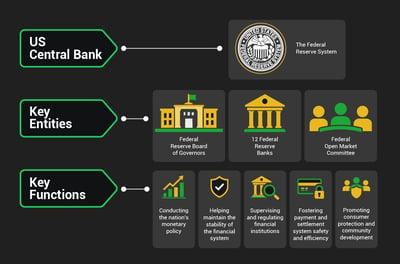
The system consists of 12 regional Federal Reserve Banks overseen by the Federal Reserve Board of Governors in Washington, D.C.
The Fed’s Core Mandate
The Fed operates under what is known as the dual mandate, a policy framework set by the US Congress. Its two main objectives are:
Maximum employment: supporting conditions that allow as many people as possible to find work.
Price stability: keeping inflation under control so that purchasing power remains stable.
That’s why the Fed typically aims for inflation of around 2% over the long run, a level considered consistent with sustainable economic growth.
Is the Fed Government or Independent?
The Fed was created by Congress and is accountable to it, but it operates with a high degree of independence in day-to-day decision-making.
This structure allows the Fed to focus on long-term economic stability rather than immediate political priorities.
How the Federal Reserve Is Structured?
The Federal Reserve System is designed as a national institution with regional representation. Three main bodies make up the system:
The Board of Governors,
The Federal Open Market Committee (FOMC), and
The 12 regional Federal Reserve Banks.
Here’s how each part of the structure works:
Board of Governors
The Federal Reserve Board of Governors consists of seven members, each appointed by the US president and confirmed by the Senate. Governors serve 14-year terms, which are designed to be long to avoid political pressure.
The Chair of the Federal Reserve, currently Kevin Warsh, who succeeded Jerome Powell in May 2026, plays a particularly influential role. The chair communicates policy direction to markets and leads discussions that shape monetary decisions.
FOMC
The FOMC is a crucial policy body. It sets the federal funds rate, the key interest rate that influences borrowing costs across the whole US economy. The FOMC has 12 voting members:
The seven members of the Board of Governors
The president of the Federal Reserve Bank of New York
Four of the remaining 11 regional Fed bank presidents, who rotate voting rights each year
The committee meets eight times per year, reviewing economic data like inflation, employment, and financial conditions. After each meeting, it announces its policy decision and releases a statement explaining its outlook for the economy. For example, at its 16 September 2026 meeting the FOMC raised the target range for the federal funds rate by 0.25 percentage point to 3.75–4.00%, its first hike since 2023 (Federal Reserve, September 2026).
Regional Federal Reserve Banks
The system also includes 12 regional Federal Reserve Banks, located in cities such as New York, Chicago, San Francisco, and Dallas. These banks:
Implement monetary policy decisions
Supervise regional banking institutions
Gather economic data from businesses and communities
The regional structure helps ensure that monetary policy reflects conditions across the entire country, not just the financial centers on the coasts.
The Fed’s Main Policy Tools
The Federal Reserve System tools allow the central bank to adjust financial conditions, manage inflation, and stabilize markets during periods of stress. Here are the main tools:
Interest Rates
The Fed’s most visible and influential tool is the benchmark interest rate.
When the Fed raises rates:
Borrowing becomes more expensive
Consumer spending and business investment tend to slow
Inflation pressures are reduced
When the Fed cuts rates:
Credit becomes cheaper
Businesses and households are encouraged to borrow and spend
Economic growth is stimulated
Interest rate changes ripple through nearly every major financial market:
Stocks: Higher rates normally weigh down equities because future profits are discounted more heavily and borrowing costs rise.
Bonds: Bond prices move inversely to interest rates. When the Fed raises rates, existing bond prices usually fall while yields rise.
US Dollar: Higher interest rates often strengthen the United States dollar because global investors seek higher yields.
Housing and Credit Markets: Mortgage rates, credit cards, and business loans tend to rise or fall with the Fed’s policy direction.
Open Market Operations (OMO)
OMOs are the Fed’s routine method of implementing monetary policy. The Fed buys or sells US government securities in financial markets. This tweaks the amount of liquidity in the banking system and helps guide short-term interest rates toward the Fed’s target. For example:
Buying securities adds money to the financial system and supports lower interest rates.
Selling securities removes liquidity and helps tighten financial conditions.
The Federal Reserve Bank of New York carries out these transactions on behalf of the Fed.
Quantitative Easing (QE)
When normal rate cuts are no longer enough — usually this happens when interest rates are near zero — the Fed may turn to QE.
This involves massive purchases of government bonds and other financial assets to inject liquidity directly into the financial system. By doing this, the Fed hopes to:
Lower long-term interest rates
Support credit markets
Encourage investment and risk-taking
More experienced traders may remember that this policy was used extensively during the 2008 global financial crisis and again during the COVID-19 pandemic.
Quantitative Tightening (QT)
QT is the opposite of QE. Rather than purchasing assets, the Fed cuts its balance sheet by allowing bonds to mature without reinvesting the proceeds or by selling securities outright. QT is designed to drain liquidity from the system, and can:
Push interest rates higher
Tighten financial conditions
Reduce excess liquidity in markets
Because liquidity plays a major role in asset prices, QT often has a big impact on stocks and other risk assets.
Forward Guidance
Forward guidance is when the Fed outlines its future policy intentions to markets. It’s intended to be a calming and authoritative voice that influences how investors act when things are unclear. That’s why the Fed will issue:
Policy statements after FOMC meetings
Economic projections
Speeches by Fed officials
The Fed’s “dot plot” of interest rate expectations
These signals help shape market expectations about future interest rates.
Emergency Tools in Crisis
When a severe financial crisis hits, the Fed can turn to a range of emergency tools designed to stabilize markets. These tools have included:
Emergency lending facilities for banks and financial institutions
Liquidity programs for corporate bond markets
Support for money market funds
Large-scale asset purchases to restore market functioning
Such measures were used during the 2008 financial crisis and again in 2020, when the Fed moved rapidly to prevent a global liquidity freeze.
How Fed Policy Flows Into Financial Markets?
The influence of the Fed is not confined to the banking system. Through interest rates, liquidity conditions, and market expectations, Fed policy flows directly into financial markets and influences how investors price risk across asset classes. Here are some of the Fed’s most important effects:
Liquidity: The Hidden Driver of Asset Prices
Liquidity is all about how much money there is in the financial system. It’s one of the most powerful forces that can shape asset prices.
When the Fed adds extra liquidity into the system through policies like rate cuts or QE, it’s designed so that:
Borrowing becomes easier
Capital flows more freely through financial markets
Investors will often respond to this by increasing their exposure to riskier assets such as stocks, high-yield bonds, and cryptocurrencies. They do this because they have more confidence in a liquid market than an illiquid market. That’s why when liquidity is down, financial conditions tighten.
Interest Rates and Asset Valuation
Interest rates influence how investors value almost every financial asset.
Stocks: Higher interest rates normally pressure equities, especially growth stocks that have valuations that depend heavily on future earnings.
Bonds: Bond yields move closely with monetary policy. When the Fed hikes rates, bond yields tend to rise also, and bonds that have already been issued fall in price.
Risk Assets: Higher borrowing costs can make it a bad idea to use leverage and speculate on financial trading, which often affects assets like tech stocks and cryptocurrencies.
The Fed and the US Dollar
The Fed’s interest rate policy directly affects the value of the United States dollar. We’ve written an article on why the US dollar is so strong.
When US interest rates rise relative to other major economies, global investors will hastily shift capital into US assets to access higher returns. This increased demand normally strengthens the dollar.
On the other hand, when the Fed cuts rates or creates easier policies, the dollar can weaken as capital flight from the dollar takes place because investors seek higher yields elsewhere.
That’s why currency markets watch Fed policy very closely. It’s not uncommon for shifts in interest rate expectations to drive large movements in FOREX markets.
Commodities and Inflation Expectations
Fed policy also affects commodities. This is because investors tend to have certain inflation expectations based on the strength of the dollar.
When investors think inflation will rise, demand shoots up for commodities like gold, silver, and oil, which are viewed as hedges against declining purchasing power.
But it’s important to note that higher interest rates can sometimes weigh on commodities, especially precious metals, because rising yields make it less attractive to hold a non-yielding (albeit safe) asset like gold.
The Fed Cycle and How Markets Typically React
As we’ve said, financial markets around the world are very sensitive to policy decisions from the Fed. Rate hikes, policy pauses, and rate cuts are all keenly watched by investors. Here’s more detail on each:
Rate Hiking Cycles
A rate-hiking cycle happens when the Fed methodically lifts interest rates to slow inflation and stop the economy from overheating. What normally happens at these times includes:
Borrowing costs rise
Credit conditions tighten
Liquidity in financial markets declines
Markets will often act differently, depending on the point during the cycle at which the tightening actually occurs.
Early tightening: Sometimes markets prefer this. If the economy is strong and inflation does not run away, investors sometimes feel that rate hikes signal a healthy economy.
Late tightening: When rates jump aggressively after inflation has already surged, investors become concerned about slower growth
Normally, increased market volatility can coincide with later stages of hiking cycles.
Historical Market Behavior
Common market behavior includes when equities rise early in a tightening cycle, especially if corporate earnings are strong. But, as higher borrowing costs start to bite, investors see financial conditions tighten.
You’ll typically see bond markets react faster than equities. Rising interest rates push bond yields higher and prices lower, reflecting expectations of tighter monetary policy.
FOREX markets can also be counted on to respond quickly to rate changes, with the US dollar often strengthening during tightening phases as investors go on the hunt for higher yields.
Rate Cuts
The Fed is also known to cut rates when the economy is flatlining. Lower interest rates are intended to:
Stimulate borrowing and spending
Support investment
Stabilize financial markets
Rate cuts are often considered good news for equities and risk assets, especially if investors believe the policy shift will extend economic growth.
Why Markets Sometimes Fall after Cuts
It happens fairly often, but is less understood; stocks sometimes fall after the Fed begins cutting rates, which seems counterintuitive.
This normally happens because many times rate cuts come too late, since the economy has already shown signs of struggling. It’s helpful to think that in this case, the Fed is actually responding to weakness rather than preventing it.
Recession Signaling
Recession is a word that can rattle markets, so markets sometimes panic at the first rate cut because they see it as a sign that economic risks are increasing.
Bond markets are known to anticipate this shift early. The best investors have their eye on the ball, and when they expect slower growth, they pivot to buying longer-term government bonds. This pushes yields lower before the Fed even changes policy.
That is usually what traders mean when they say markets have “priced in” a policy shift.
Pivot Moments and Why Traders Anticipate Them Early
A “Fed pivot” is the moment when the Fed decisively moves from raising interest rates to cutting them. A pivot means that policymakers believe their interventions (tightening or easing) have been successful and are not needed anymore.
Professional investors don’t wait for the Fed to openly announce a pivot. They would rather try to anticipate pivots by analyzing economic data. That’s why some of the largest market moves take place before the Fed actually pivots.
Key Fed Indicators Traders Should Watch
Because monetary policy decisions from the Federal Reserve System depend heavily on economic data, traders watch several economic indicators. These data points often shape market expectations:
CPI and PCE Inflation
Inflation is a key consideration that guides Fed policy. Here are two inflation-related numbers that get the most attention and why:
Consumer Price Index (CPI): It tracks changes in the price of goods and services paid by consumers.
Personal Consumption Expenditures (PCE): This is the Fed’s preferred inflation gauge because it captures a broader range of spending patterns.
This leads to the well-known situation that higher inflation leads to tighter monetary policy; but on the other hand, softer inflation data leads to expectations of rate cuts or policy easing.
Nonfarm Payrolls
The nonfarm payrolls report is a monthly report that measures how many jobs were added or lost in the US economy.
Strong payroll growth normally means a healthy economy, but it can also raise concerns that inflation might persist. On the other hand, weak job growth might send a message of slowing economic momentum and up the likelihood of policy easing.
Because employment is one part of the Fed’s two-part mandate, payroll data often has a big impact on market reactions.
Unemployment Rate
The unemployment rate is another important marker of the health of the economy.
A low unemployment rate most often means strong economic activity and tight labor markets, conditions that can contribute to wage inflation.
But higher unemployment tells markets that economic conditions are deteriorating, something that could eventually push the Fed toward rate cuts.
Wage Growth
If wages increase too quickly, companies could raise prices to offset higher labor costs. Because of this, Fed policymakers often want to watch wage indicators to keep tabs on whether inflation pressures are becoming entrenched.
Better-than-expected wage data can therefore lead investors to expect higher interest rates for longer.
Treasury Yields (Especially the 2-Year)
Bond markets often provide the clearest signal of how investors expect Fed policy to evolve.
In particular, the two-year US Treasury yield is closely tied to expectations for short-term interest rates set by the Fed.
When the two-year yield rises sharply, it often reflects expectations that the Fed will raise rates or keep them elevated. When it falls, markets may be pricing in future rate cuts.
Because of this sensitivity, many traders treat the two-year yield as a real-time gauge of Fed policy expectations.
Financial Conditions Index
The Financial Conditions Index (FCI) is a combination of several indicators, including:
interest rates
credit spreads
market volatility
When financial conditions are loose, credit is easily available, and risk-taking gets better across markets. But when conditions tighten, borrowing costs shoot up, and economic activity may slow.
What Are Some Common Misunderstandings About the Fed?
Despite the huge influence of the Fed, there are a lot of myths about it:
The Fed Can’t Control Mortgage Rates
Yes, the Fed controls the federal funds rate, but this is just a short-term interest rate that banks charge each other for overnight lending. This rate is different from actual mortgage rates, which are tied more closely to longer-term Treasury yields.
Fed policy influences these yields through expectations for:
inflation
growth
future interest rates
In saying all that, it does not set mortgage rates directly. This is why mortgage rates can sometimes rise even when the Fed has not changed its policy rate.
The Fed Does Not “Print Money”
Unlike what some people think, the Fed does not physically print cash to inject into the economy. Rather, most of its actions are all about adjusting liquidity within the banking system.
As we’ve said, during a cycle of QE, the Fed will buy financial assets like government bonds. In exchange, it credits the reserve accounts of banks. These reserves boost the liquidity in the financial system, but that said, they do not automatically translate into new spending or consumer cash.
The Fed Can’t Fully Control Inflation
Although controlling inflation is important, the Fed does not have complete control over price levels. Inflation is influenced by many factors beyond monetary policy, including:
Global supply chains
Energy and commodity prices
Fiscal policy and government spending
Geopolitical events
Consumer behavior and expectations
The Fed’s tools mainly affect demand within the economy. It takes time for measures to seep through. Because of this, inflation control is often a gradual process rather than an immediate outcome of any single policy decision.
Criticism and Limits of Federal Reserve Policy
While the Federal Reserve System plays a central role in guiding the economy, its policies are not without limitations or controversy. Economists, investors, and policymakers frequently debate how effective the Fed’s tools are and whether its actions sometimes create unintended consequences.
Slow Effects of Monetary Policy: The effects of policy do not appear immediately. Changes in borrowing costs take time to filter through the banking system and household spending. Economists often estimate it can take six months to two years to fully influence economic activity and inflation.
Political Pressure Risks: Although the Fed is ostensibly independent, it still exists in a political environment. Government officials, lawmakers, and even presidents (as seen publicly during Trump’s second term) have tried to influence the central bank’s decisions.
The Asset Bubbles Debate: Another common criticism is that very low interest rates and bounteous liquidity can contribute to asset bubbles. Some critics say the Fed’s policies after the 2008 financial crisis and during the COVID-19 pandemic helped fuel strong rallies in asset prices, raising concerns that markets became detached from underlying economic realities.
Inequality Concerns: Fed policies can also have uneven effects across different groups within the economy. QE pushes asset prices higher, and households that own financial assets like stocks and real estate benefit more than poorer families.
Why the Fed Matters More Today Than Ever
The influence of the Fed has kept growing over the decades. The world is now so much more global and interconnected than before. Fed decisions shape not only the US economy but also capital flows, asset prices, and financial conditions worldwide.
Here’s what’s amplified the Fed’s impact on markets:
Global Reserve Currency Status
The US dollar is still the world’s dominant reserve currency. It’s used widely in international trade, global finance, and central bank reserves.
Therefore, any changes in US monetary policy have an impact across global markets. When the Fed hikes interest rates, capital tends to flow toward US assets offering higher yields. Conversely, when the Fed loosens policy, global liquidity flows into riskier assets and international markets.
Financialization of Markets
In recent decades, global markets have become increasingly financialized, which is to say, financial assets and credit markets play a larger role in the broader economy.
Corporate borrowing, equity markets, real estate financing, and global capital flows are now closely linked to interest rates and liquidity conditions. It’s no surprise that Fed decisions affect not only banks but also big companies, investment funds, and households.
Algorithmic Trading Reacting to Fed Signals
Modern financial markets have migrated to data-driven algorithmic and quantitative trading systems. These systems analyze economic data releases, central bank statements, and speeches from Fed officials in real time.
It shouldn't surprise you that even tiny changes in language can trigger rapid trading activity across global markets.
Global Spillover Effects
One of the biggest signs of the Fed’s outsize influence is the scale of its global spillover effects. When the Fed tightens policy, global liquidity often contracts, affecting borrowing costs and capital flows around the world.
You’ll find that even emerging markets can experience currency pressure, rising debt servicing costs, and reduced access to financing.
When the Fed loosens policy, the opposite can occur, and global investors go looking for higher returns abroad.
How Can I Interpret Fed Signals?
For investors big and small, interpreting Fed signals can provide a useful framework for understanding broader market direction. Here’s what to watch out for:
When the Fed Is Tightening
Typical market reactions include:
Stronger US dollar: Higher interest rates tend to attract global capital into US assets, strengthening the dollar.
Pressure on growth stocks: Companies whose valuations depend heavily on future earnings - think tech firms - tend to be sensitive to rising interest rates.
Higher bond yields: Government bond yields usually go up as markets price in tighter monetary policy.
Increased market volatility: As liquidity tightens, markets often become more sensitive to economic data and policy signals.
When the Fed Is Easing
Common market responses include:
Risk assets rally: Risk assets like stocks and high-yield bonds benefit from lower borrowing costs and increased liquidity.
Liquidity expands: Increased credit availability encourages investment and risk-taking through many financial markets.
Weaker dollar: Lower interest rates can make dollar-denominated assets less appealing, sometimes leading to a softer currency.
Support for commodities: Easier monetary policy and the prospect of better inflation numbers can boost commodities such as gold and oil.
Neutral Policy Periods
During times that are stable, so-called neutral phases, the influence of macro policy becomes less important. At times like these:
Choosing the right stock becomes more important than the bigger trends
Corporate earnings and sector fundamentals drive market performance
Volatility can decline as monetary policy uncertainty fades
Recognizing which phase of the monetary cycle the market is currently in can help you make better investment decisions.
The Bottom Line
The Federal Reserve System shapes the conditions that influence nearly every major asset class. From equities and bonds to FOREX, commodities, and cryptocurrencies, markets constantly adjust to signals coming from the central bank.
Rate hikes, rate cuts, balance sheet policies, and forward guidance all play a big part in deciding how capital flows across global markets. For traders and investors, understanding the Fed is about understanding the broader rhythm of market cycles.
FAQ
What is the Federal Reserve, and what does it do?
The Federal Reserve System is the central bank of the United States. Its main responsibilities include managing monetary policy, supervising banks, maintaining financial stability, and supporting the economy through its dual mandate of maximum employment and stable prices.
Why do financial markets react so strongly to Fed decisions?
Fed policy influences interest rates, liquidity, and borrowing costs, which affect how investors value assets. When the Fed signals changes in policy, markets quickly adjust expectations for economic growth, inflation, and risk, leading to movements in stocks, bonds, currencies, and commodities.
What is the federal funds rate?
The federal funds rate is the benchmark interest rate set by the Federal Open Market Committee. It represents the rate at which banks lend reserves to each other overnight and serves as the foundation for many other interest rates in the economy.
When does the Fed meet to set interest rates?
The FOMC typically meets eight times per year to assess economic conditions and determine whether monetary policy should be tightened, loosened, or left unchanged.
What is quantitative easing?
QE is a monetary policy tool used when interest rates are already very low. Under QE, the Fed purchases large amounts of government bonds and other financial assets to inject liquidity into the financial system and support economic activity.
What is a Fed pivot?
A Fed pivot refers to a shift in monetary policy direction, usually when the Fed moves from raising interest rates to pausing or cutting them. Markets often react strongly to signs that a pivot may be approaching.
Does the Fed control mortgage rates?
No. The Fed does not set mortgage rates directly. Mortgage rates are more closely tied to long-term Treasury yields, although Fed policy can influence those yields indirectly through interest rate expectations and financial conditions.
Why do markets sometimes fall when the Fed cuts rates?
Rate cuts often occur when economic conditions are already weakening. As a result, markets may initially react negatively if investors interpret rate cuts as a sign that recession risks are rising.
Why is the Fed important for traders?
Because Fed policy shapes liquidity and borrowing costs, it often drives major market cycles. Traders monitor Fed signals closely to anticipate shifts in interest rates, inflation expectations, and investor risk appetite across global markets.